
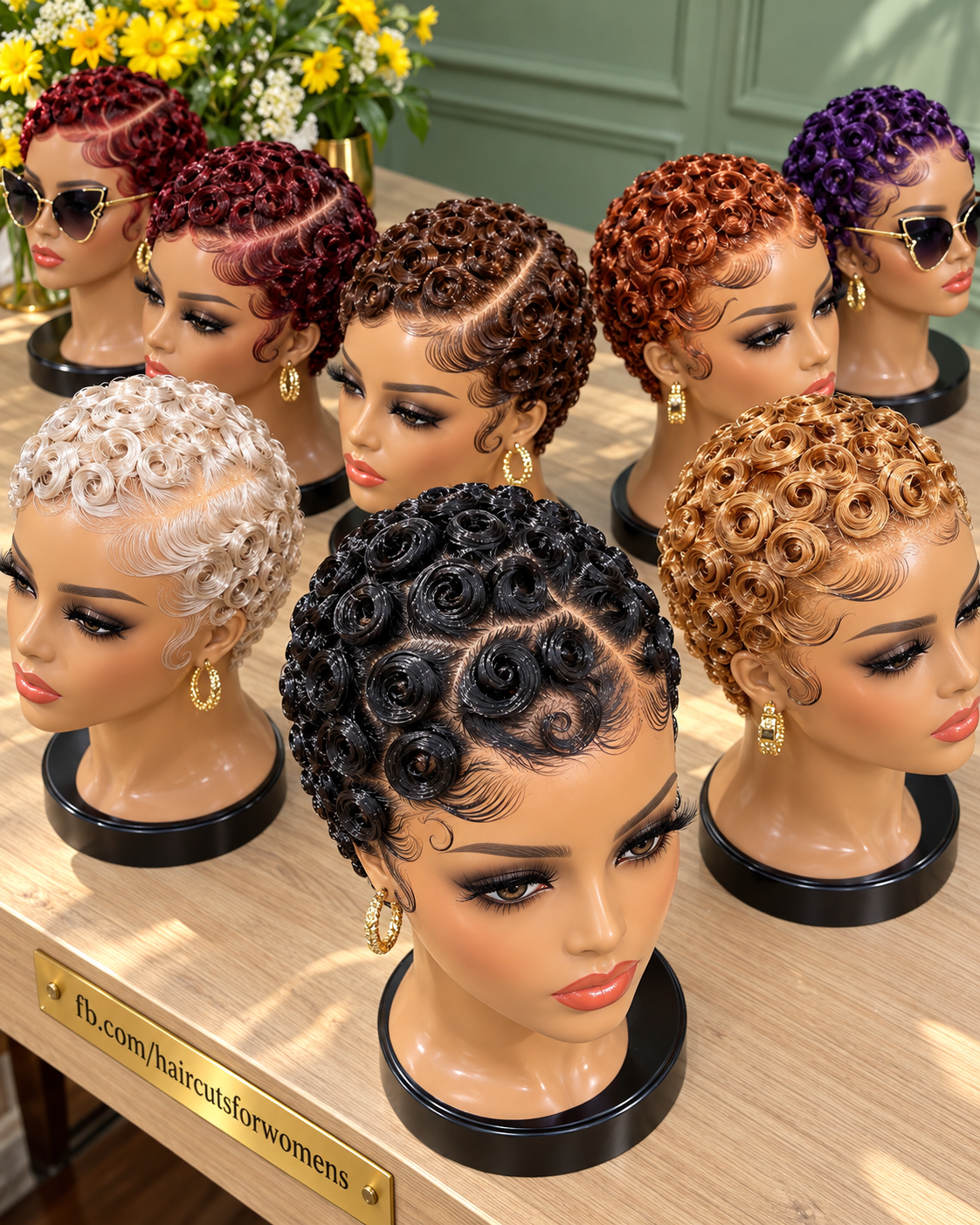
Choosing a sculpted pixie wig from a collection is a different experience from evaluating a single hairstyle. Instead of deciding whether one color looks attractive, buyers can compare how curl placement, exposed parting channels, and decorative finger waves change the character of similar compact designs. The seven-wig display in this photograph offers an excellent opportunity to make those comparisons.
Arranged across a light wooden salon table, the collection includes seven wigs displayed on realistic female mannequin heads with black circular bases. The visible colors are deep burgundy red, wine red, dark chocolate brown, bright copper, violet purple, pale platinum blonde, glossy black, and golden honey blonde. More precisely, the seven individual units consist of two burgundy-family wigs, one chocolate-brown wig, one copper wig, one purple wig, one platinum wig, one black wig, and one golden-blonde wig.
Every unit belongs to the same general family of compact sculpted pixie hairstyles, but the curl arrangements are not identical. Some emphasize small circular ringlets across the crown, while others incorporate more prominent exposed parting channels and elaborate finger-wave formations near the forehead and temples.


The mannequins are styled with makeup, earrings, and carefully arranged display positions. These accessories contribute to the presentation but should not be mistaken for included wig accessories. Likewise, the mannequin heads do not reveal the cap interiors, fiber composition, lace specifications, or attachment systems.
Reading the Collection as Seven Individual Hairstyles
The arrangement places three mannequin heads across the rear, one slightly forward near the middle, and three prominently visible in the foreground. This staggered display allows several color combinations and styling differences to be compared within one photograph.
The rear-left mannequin wears a deep burgundy-red pixie with compact curls and a sculpted side section. Its dark red color is particularly noticeable along the raised circular formations.
Beside it, another mannequin displays a richer wine-red hairstyle with closely arranged ringlets and a visible diagonal parting. The front styling includes curved strands that travel toward the temple.
Near the upper center, a chocolate-brown unit contains numerous small circular coils. Its warm brown color gives the curls a softer visual contrast than the darker burgundy examples.
To the right, a bright copper pixie displays raised circular curls with pronounced shine. The front hairline contains sweeping curved strands that connect with the crown.
The rear-right mannequin wears a vivid violet-purple wig. Its compact curls and carefully arranged front styling create a strong color contrast with the warmer shades nearby.
Across the foreground, the platinum-blonde, glossy-black, and golden-honey units provide three additional interpretations of the sculpted ringlet design.
The Black Center Wig Offers the Most Detailed Parting Arrangement
The foreground black wig deserves particular attention because its exposed parting channels are more prominent than those of several neighboring units.
Its crown contains glossy circular ringlets arranged around a series of visible diagonal and curved separations. Some curls form broad spiral openings, while smaller loops occupy the spaces between them.
The exposed channels reveal a lighter underlying surface between the dark strands. Their placement creates a distinct pattern across the upper front and side rather than a simple central part.
Near the forehead, carefully arranged finger waves extend into curved baby-hair formations. These details are especially noticeable because the black strands contrast strongly with the mannequin’s lighter complexion.
The design should not be described as an ordinary black curly pixie with no parting. Its sculpted channels and directional front styling are central to its appearance.
What Buyers Should Ask About the Black Unit
A supplier should provide a close photograph of the parting arrangement without the mannequin’s accessories obstructing the view.
Ask whether the exposed channels are established through hair placement, styling, or another construction method. Their appearance may be difficult to reproduce by simply restyling a conventional curly wig.
Request a crown photograph and a rear view to determine how the circular ringlets continue beyond the visible front section.
The black color appears glossy, but the photograph does not establish whether the fibers are human hair or synthetic.
Platinum Blonde Creates a Softer Interpretation
The foreground-left mannequin wears a pale platinum-blonde pixie with a dense arrangement of small circular curls. The shade appears creamy and slightly warm under the lighting rather than distinctly silver-gray.
The crown contains numerous closely positioned ringlets, with several larger circular openings near the upper front.
Along the hairline, the strands are arranged into flowing waves that curve across the forehead and toward the temple.
The lighter color makes the individual strand direction particularly visible. Fine lines within the waves can be distinguished more easily than on some darker units.
However, pale blonde hair can also reveal differences in density or construction more readily under strong lighting. Buyers should inspect actual product photographs carefully rather than assuming that a bright color guarantees consistent coverage.
Questions About Platinum Wig Maintenance
If the wig contains human hair that has been chemically lightened, its processing history may influence future care.
If the unit is synthetic, the pale shade may be manufactured into the fibers, and conventional toning or dyeing methods may not be suitable.
Ask the supplier how the color should be maintained and whether the curl arrangement can be restored after washing.
The photograph does not establish the material or coloring process, so care instructions should be based on verified product information.
Golden Honey Ringlets Bring Warmth to the Foreground
The foreground-right mannequin displays a golden honey-blonde pixie with numerous compact circular ringlets. Its color is warmer and deeper than the platinum unit, with golden and caramel reflections across the curls.
The upper hair forms a rounded crown, while the front strands curve into a coordinated wave pattern along the hairline.
Several ringlets appear larger near the upper front, creating visible openings between neighboring curls.
The color emphasizes the circular structure because the curved strands catch the light at different angles.
This unit is a useful comparison for customers deciding between pale blonde and warmer golden shades. Although the two wigs share a compact curly silhouette, their visual character differs considerably.
Burgundy and Wine Red Offer Two Distinct Dark-Red Options
The two red-family wigs in the rear should not automatically be treated as identical products with different display positions.
The leftmost unit appears to have a deep burgundy tone with compact curls and sculpted side styling. Its darker red color produces strong contrast between the ringlets and the underlying hair.
The adjacent wine-red wig has a slightly different visible curl arrangement, including a pronounced diagonal separation and carefully directed front waves.
Both colors belong to the burgundy family, but their brightness and undertones differ under the photograph’s lighting.
Buyers should request individual product photographs before choosing between them. Color names such as burgundy, wine red, cherry red, and auburn are not standardized across sellers.
The shape of the parting channels should also be compared independently from color. A buyer who prefers one unit’s hairline may not receive the same arrangement simply by ordering another unit in a different shade.
Copper and Purple Demonstrate Two Opposite Color Directions
The bright copper unit near the upper right introduces warm orange-brown coloring. Its circular curls reflect light strongly, emphasizing the raised spiral arrangement.
The violet-purple wig behind it provides a cooler, more saturated alternative. Its dark purple curls contrast with the warmer copper and golden-blonde examples.
These colors can appeal to customers seeking a statement hairstyle, but the purchasing decision should still consider the curl arrangement and cap construction.
A vivid shade does not compensate for a poorly fitting wig or an inaccurate hairstyle.
When evaluating either color, ask for photographs under neutral lighting. Warm salon lighting can make copper appear brighter and may shift the apparent undertone of purple.
Finger Waves and Circular Ringlets Require Different Skills
One reason this collection is visually interesting is the combination of two styling techniques.
The circular ringlets create elevation across the upper head. Their openings vary in size, and several units display tightly grouped coils that form rounded crowns.
The finger waves lie closer to the hairline and temples. Their strands follow curved paths, creating decorative ridges that contrast with the raised loops above.
These techniques should not be treated as interchangeable. A stylist experienced in ordinary curls may not necessarily specialize in precision finger-wave styling.
For custom orders, buyers should ask whether both elements are included in the finished unit and whether they can be maintained without frequent professional resetting.
Why the Hairline Should Be Evaluated Separately
The mannequin display emphasizes the front styling, but it does not reveal how each wig will fit against a real wearer’s forehead.
Some units have more prominent baby-hair curves, while others display finer waves close to the hairline.
Buyers should request photographs of the wigs removed from the mannequin heads, showing the front hairline and any lace extension.
The presence of a realistic mannequin scalp does not establish that the wig has a particular lace type or construction method.
What the Mannequin Display Cannot Confirm
The seven wigs are presented on mannequin heads with makeup and accessories. This creates an attractive retail display, but several important product details remain hidden.
The photograph does not show the underside of any wig. It therefore cannot establish the cap materials, adjustment straps, comb attachments, lace dimensions, or fastening systems.
The hair fibers also cannot be identified reliably from appearance alone. Human hair and synthetic fibers can both be styled into glossy circular curls.
Buyers should avoid assuming that every wig in the collection uses the same material or construction simply because the display is coordinated.
Each unit should be evaluated as an individual product with its own specifications.
Finding Similar Sculpted Pixie Wigs Online or Locally
Customers can begin by searching for sculpted ringlet pixie wigs, finger-wave lace wigs, and compact spiral-curl units.
Local wig boutiques may offer the advantage of examining the hairline, cap, and color before purchase.
Online sellers can provide a wider selection, but product photographs should be examined carefully. A listing that shows only a mannequin portrait may not provide enough information to evaluate construction.
Ask sellers whether the displayed hairstyle is the exact unit being sold or a representative sample.
For custom orders, provide the photograph of the preferred mannequin and identify the curl arrangement, color, parting direction, and hairline styling separately.
Questions to Ask Before Placing an Order
Confirm the hair material, available cap sizes, lace specifications, and intended installation method.
Request photographs showing the front, both sides, crown, rear, and complete underside of the selected wig.
Ask whether the curls and finger waves are delivered fully styled or require additional salon work.
Clarify whether earrings, mannequin heads, stands, or other display accessories are included. They should not be assumed to accompany the wig.
Before payment, establish the shipping costs, production timeline, return conditions, and any customization limitations.
Choosing Between Ready-Made and Custom Sculpted Pixies
A ready-made unit may be suitable for someone who likes one of the displayed color and curl combinations without requiring significant changes.
However, buyers seeking a particular parting channel or baby-hair arrangement may benefit from custom construction.
Custom work can allow more control over cap sizing, curl placement, and color selection, although the result depends on the wig maker’s skill.
Before commissioning a reproduction, ask to see examples of previous work involving circular ringlets and sculpted finger waves.
A supplier experienced only in loose curly wigs may not have the same expertise in creating compact circular formations.
Illustrative Prices for Sculpted Ringlet Pixie Wig Collections
The following USD amounts are illustrative budgeting ranges rather than verified current product prices. They do not represent confirmed selling prices for the seven displayed wigs.
| Wig Category | Illustrative USD Range | Potential Cost Considerations |
|---|---|---|
| Premium Custom | $320–$760+ | Individual cap sizing, detailed circular ringlet arrangement, specialized finger-wave styling, and personalized color placement. |
| Standard Custom | $175–$390 | Selected cap options with customized curls, hairline styling, and available color choices. |
| Basic Human Hair | $100–$265 | A human-hair starting unit that may require professional curl setting and finger-wave customization. |
| Premium Synthetic | $75–$190 | A manufactured pixie with preformed circular curls and possible sculpted front styling. |
| Basic Synthetic | $30–$90 | A lower-cost curly pixie alternative that may not reproduce the detailed parting and finger-wave arrangements. |
Prices may vary between the displayed color options depending on the material and manufacturing process.
Pale blonde, copper, burgundy, and purple colors may involve different production methods, particularly when custom human-hair coloring is requested.
Detailed circular curls and finger-wave hairlines can also increase labor costs.
Additional charges may include lace customization, cap fitting, shipping, taxes, and professional installation.
Ask for an itemized quotation for the specific wig rather than assuming that every color in a collection has the same price.
Booking a Stylist for the Selected Wig
After purchasing, the first fitting should establish the correct cap position and hairline placement.
A professional wig stylist can assess whether the front waves sit appropriately against the wearer’s forehead and whether the curls retain their intended shape.
If the unit includes untrimmed lace, the correct fit should be established before trimming.
The stylist should also inspect the curls for compression caused by shipping.
Any restoration method should depend on the confirmed fiber type and manufacturer instructions.
Heat styling should not be applied automatically because different materials have different tolerances.
Maintaining Seven Different Color Options
Although the displayed wigs share a similar styling family, their maintenance requirements may differ according to material and coloring method.
For human-hair units, previously lightened or colored strands may require particular attention during washing and restyling.
For synthetic units, conventional dyeing and heated tools may be unsuitable. Manufacturer instructions should determine which products are safe.
The circular ringlets should be handled carefully to preserve their openings, while the finger-wave sections should be protected from brushing that disrupts their directional ridges.
Store each wig on an appropriately sized stand that supports the compact crown without flattening the curls.
Keeping the Front Styling Recognizable
The sculpted hairlines are important elements of these designs. Repeatedly brushing the baby-hair curves or moving strands across the exposed parting channels may change their appearance.
If the front styling becomes irregular, consult a professional before attempting extensive restyling.
For travel, use protective packaging that provides enough room for the raised ringlets and prevents any lace from snagging.
Comparing the Collection Before Making a Final Choice
The seven-wig display demonstrates how similar compact ringlet hairstyles can produce very different impressions through color and styling placement.
The platinum and golden-blonde units emphasize the circular curl formations through lighter coloring. The burgundy and wine-red examples introduce deeper warmth, while the copper and purple wigs provide more saturated alternatives.
The chocolate-brown unit offers a restrained warm option, and the glossy black foreground wig places particular emphasis on exposed parting channels and sculpted hairline detail.
Rather than choosing solely by color, buyers should compare the curl arrangement, hairline styling, parting position, cap construction, and maintenance requirements.
Before ordering, verify the material and specifications of the individual unit. Request complete photographs and confirm whether the advertised price includes the finished hairstyle.
The most suitable choice will be the wig that combines the preferred color with the desired ringlet size, front-wave arrangement, comfortable cap fit, and realistic maintenance expectations. Those considerations provide a practical basis for selecting a ready-made piece or commissioning a custom version inspired by this seven-wig salon collection.
Search Terms
Seven color sculpted ringlet pixie wigs · Burgundy finger wave circular curl wig · Platinum blonde spiral pixie mannequin · Glossy black parted ringlet lace hairstyle · Copper orange finger coil crown wig · Violet purple sculpted baby hair pixie · Golden honey circular ringlet wig · Chocolate brown compact spiral curl unit