
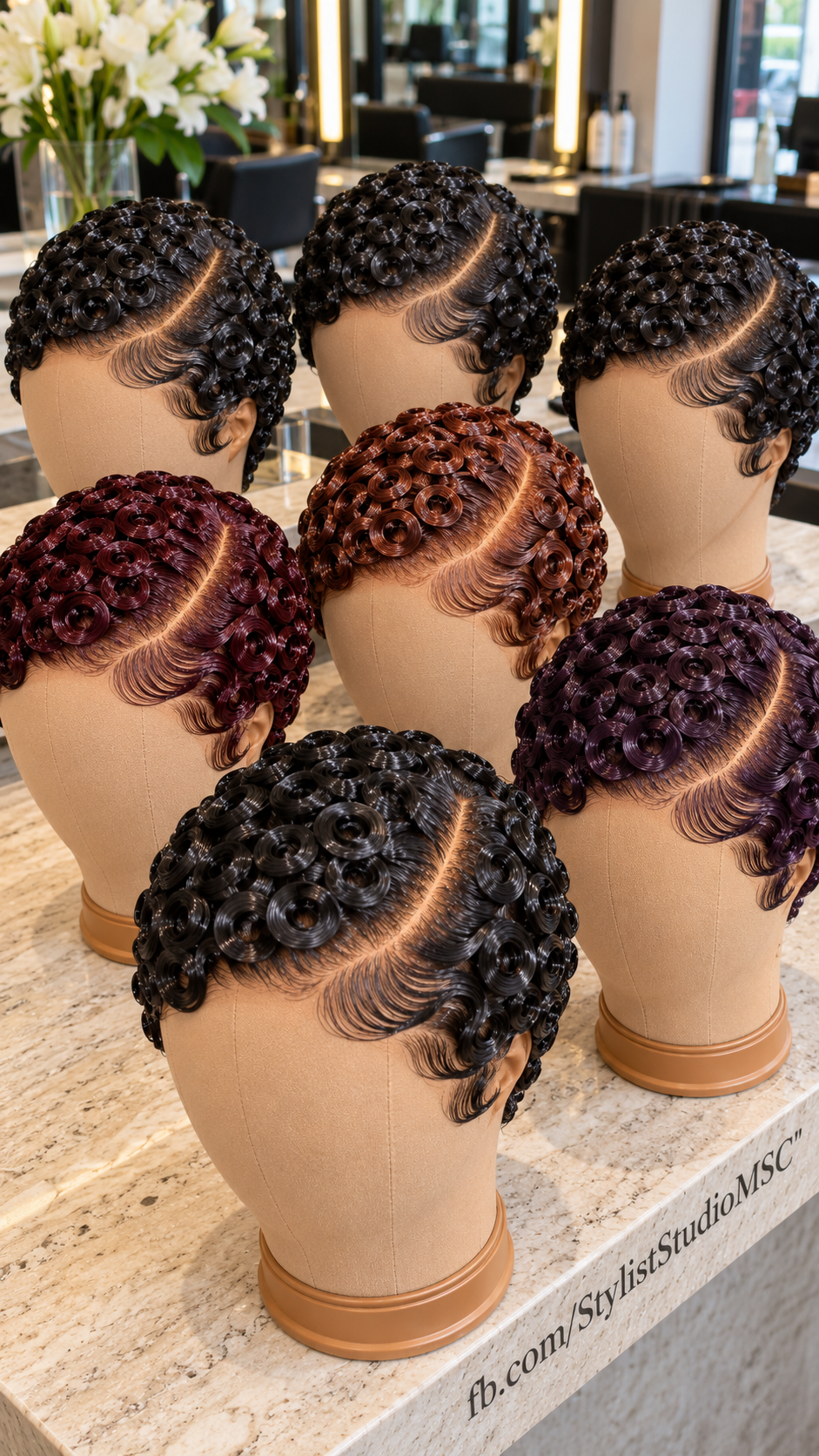
A carefully arranged collection of sculpted pixie wigs offers a valuable opportunity to compare more than color. In this salon display, seven compact hairstyles share a recognizable design language: tightly arranged circular ringlets across the crown, prominent diagonal partings, sweeping finger waves along the forehead and delicate curls near the temples. Yet the collection contains visible differences in curl placement, color depth and the way each hairstyle frames the face.
The wigs are presented on faceless, head-shaped display forms arranged in two rows on a pale stone salon counter. Three black units occupy the back row, while the foreground includes burgundy, copper-auburn, deep black and dark plum variations. Each piece uses a rounded crown filled with small circular curls, but the size and distribution of those ringlets vary across the display.
The front-center black wig provides an especially clear view of the styling. Its crown carries numerous glossy tubular coils, a diagonal scalp-toned part curves across the upper side, and long feathered strands sweep toward a curled temple accent. The copper-auburn and burgundy pieces show how similar styling principles can create a distinctly different appearance when applied to warm hair colors.


For customers and wig businesses, this display is best approached as a comparison of finished exterior designs. The units are mounted on display forms, so their internal construction, lace materials, fastening mechanisms and fiber composition cannot be established from the image. Those specifications need confirmation before a purchase or custom order.
All seven wigs belong to a compact sculpted spiral family, but their visible details should be examined separately. Several crowns contain tightly packed circular coils with open centers, while others show a slightly broader curl arrangement. The diagonal parting also differs in its apparent placement and surrounding wave construction.
The shared theme is recognizable: a rounded curly crown above a directional finger-wave section. However, a shopper should not assume that selecting a different color automatically preserves every individual curl and parting detail.
For custom ordering, the most reliable approach is to identify the preferred display unit first. The maker can then discuss whether its exact construction is available in another shade.
The Foreground Black Wig Offers the Clearest Parting Reference
The large black wig nearest the viewer contains a dense upper arrangement of circular coils. Several ringlets have clearly visible hollow centers, while smaller formations fill the gaps around them.
A pronounced diagonal part travels from the forward upper section toward the side. Beneath it, fine black strands form a broad feathered wave that curves across the front and transitions toward the temple.
This division gives the hairstyle its asymmetry. The rounded curls remain concentrated above the part, while the lower section follows a flatter direction.
Someone commissioning the foreground design should provide a close reference showing the complete diagonal path and the relationship between the upper circles and lower waves.
The Crown Depends on Compact Circular Curl Placement
The ringlets are arranged into individual tubular formations rather than ordinary loose hanging curls. Many resemble small rolled circles with dark openings at their centers.
These openings make each curl recognizable and create shadow within the densely populated crown.
The rings are positioned close together, but the larger formations remain distinguishable. Smaller curls provide coverage around the main openings and follow the rounded shape of the wig.
A professional reproduction should balance curl diameter and density. Adding too much hair between the circles could conceal the very structure that makes the hairstyle distinctive.
Black Wigs Reveal Their Detail Through Light and Shadow
The three black wigs in the back row and the foreground black unit show how a single dark color can display substantial variation through styling.
Glossy outer strands reflect the salon lighting, while the interiors of the curls remain deep black. The contrast between those surfaces makes the circular formations visible without introducing colored highlights.
This is important for customers who prefer monochromatic hairpieces. Precision curl placement can create visual depth even when the palette remains consistent.
When ordering black, the buyer should still compare the crown shape, curl diameter and front-wave direction rather than treating every black unit as interchangeable.
The Burgundy Wig Offers a Rich Wine-Red Interpretation
The foreground burgundy wig introduces a deep red color family with glossy wine and cherry reflections. Its circular crown contains numerous compact ringlets, while a diagonal part and sweeping front strands provide the same general styling language as the darker units.
The color changes how the curl structure is perceived. Raised surfaces reflect brighter burgundy, while recessed areas remain darker, creating depth within individual circular forms.
For buyers considering this shade, a neutral-light photograph is useful. Salon lighting can make wine-red hair appear more vivid than it does in daylight.
The visible arrangement should also be approved independently from the color, since the crown and side details are not necessarily identical to the black examples.
The Copper-Auburn Wig Creates a Warmer Focal Point
The center wig in the second row uses a vibrant copper-auburn palette. Its ringlets display reddish-brown and orange-copper reflections, making the individual circular surfaces especially noticeable.
The diagonal part forms a clear separation beneath the crown, and fine directional strands sweep toward the front temple.
Compared with the burgundy unit, the copper version emphasizes warmer orange-brown reflections rather than deeper wine-red tones.
A custom order should distinguish copper auburn from bright orange or golden blonde. Those shade families can produce noticeably different results even when the curl construction remains similar.
Dark Plum Adds a Cooler Red-Purple Alternative
The foreground wig on the right appears within a deep plum or aubergine color family. Its curls contain dark purple-red reflections, producing a cooler appearance than the copper and burgundy examples.
Its prominent diagonal part and feathered front waves remain important visual details. The glossy circular coils create a dense rounded crown while the side curls remain more compact.
Customers should use the image as a color reference rather than relying only on labels such as plum, burgundy or purple. These descriptions can vary between suppliers.
The exact shade should be confirmed with photographs of the available hair under neutral lighting.
The Front Finger Waves Are a Major Part of the Collection
Across the display, long directional strands follow the forehead and temple areas beneath the circular crowns. Several wave sections are broad enough to become distinct visual elements rather than incidental baby hairs.
The strands sweep in elongated curves, sometimes ending in smaller circular accents near the side of the display form.
This creates a gradual transition between the dense upper curls and the lower perimeter.
A custom stylist should preserve the different styling techniques. The large circular crown should not be extended through the entire front, and the feathered waves should not be converted into additional tubular coils.
The Diagonal Partings Shape the Face-Framing Arrangement
Each clearly visible unit uses a prominent exposed diagonal part. The path creates a boundary between the rounded crown and the finer front styling.
The angle of the part influences the appearance of the curls around the forehead. A deeper division can create stronger asymmetry, while a shallower route may distribute the upper hair more evenly.
For made-to-order production, the maker should establish the part before arranging the surrounding curls.
Customers should request approval photographs showing the parting direction rather than assuming that every unit in the collection has the exact same placement.
The Lower Temple Curls Complete the Design
Several wigs display small curled sections near the sides of the display forms. These accents sit below the larger crown curls and follow the direction of the front-wave styling.
Their scale is deliberately smaller than the major ringlets above.
For custom reproduction, the temple curls should remain proportional. Enlarging them excessively could change the face-framing balance, while removing them may make the side appear less distinctive.
A direct side photograph can help the customer specify the intended shape and position.
The Rounded Silhouette Remains Compact Across the Collection
Despite the large number of visible coils, the wigs retain compact proportions. The curls concentrate around the crown instead of extending downward into long hanging lengths.
This creates a raised upper silhouette while allowing the diagonal partings and temple details to remain visible.
For buyers, compact length should not automatically be equated with minimal styling work. Constructing numerous small circular coils and arranging delicate perimeter waves can require considerable professional labor.
The Collection Is Useful for Choosing a Color Before Customization
Displaying several related hairstyles together allows customers to compare black, burgundy, copper-auburn and plum under approximately similar lighting conditions.
However, color should be chosen alongside the preferred curl construction. A customer may like the shade of one unit but prefer the crown density or front-wave placement of another.
Custom makers may be able to combine those preferences, depending on available hair and styling capabilities.
Such requests should be confirmed before production rather than assumed possible from the display alone.
The Display Forms Do Not Reveal the Interior Construction
The wigs are shown fitted to head-shaped forms, so the image does not provide a reliable view of their cap interiors.
It is therefore not possible to confirm their exact lace grades, attachment systems, fiber types or installation methods.
A natural-looking parting in a display photograph does not automatically establish HD lace.
Before purchasing, ask the seller to remove the selected unit from its display form and photograph the underside. This can help clarify the actual cap construction and available fitting options.
Cap Size Should Be Confirmed Before Ordering
The diagonal part and decorative front waves are fixed to each wig’s foundation. Their final position changes if the cap sits too far forward or backward.
This makes sizing important for visual accuracy as well as comfort.
For custom orders, follow the maker’s measurement instructions. Depending on construction, circumference, ear-to-ear and front-to-nape dimensions may be required.
A professional wig stylist can help determine whether a standard cap size is suitable.
Finding a Maker for Sculpted Finger-Coil Wigs
Specialist wig makers, custom lace-wig studios and salons experienced with finger-coil styling are practical places to begin.
The maker should be able to produce numerous circular curls with visible openings, arrange a diagonal part and create elongated finger waves along the perimeter.
Experience with ordinary loose curls alone may not demonstrate the necessary precision.
When evaluating a portfolio, request elevated crown photographs and detailed front views showing the individual coils and wave construction.
Where to Buy Comparable Color Variations
Beauty supply retailers and wig studios may offer compact spiral wigs in black, burgundy, copper and other warm or cool shades.
A ready-made unit is useful when the chosen color and styling already match the buyer’s preference.
Custom production may be more appropriate when the buyer wants the crown construction of one display unit combined with another unit’s color.
Before ordering, ask whether the seller can supply the exact photographed styling or only a similar foundation.
Booking a Salon Appointment for Fitting or Customization
The amount of work required depends on whether the wig arrives fully styled.
A completed unit may need fitting and minor adjustments. An unfinished base may require extensive curl setting, parting construction and front-wave styling.
When booking, identify the preferred display unit and explain whether the color or hairstyle needs modification.
This helps the salon determine the appropriate services and appointment duration.
A Custom Order Should Specify the Chosen Wig Individually
The buyer should begin by identifying the exact unit in the photograph.
The crown specification should describe the preferred ringlet size, density and circular openings.
The front requirement should establish the diagonal parting and direction of the feathered waves.
Color should be selected separately, using an actual shade reference.
Cap size, lace construction, attachment preferences and installation requirements should then be confirmed with the seller.
Approval Photographs Should Not Rely on the Group Image
A group display is useful for comparison, but it cannot show every detail of an individual wig.
Before purchasing, request a close front photograph of the selected unit, followed by side, rear and elevated crown views.
If cap construction matters, ask for a separate underside image.
These photographs help establish whether the actual product matches the chosen reference rather than merely belonging to the same styling family.
Pricing Depends on Curl Construction and Color Work
The wigs are compact, but their crowns contain numerous individually arranged coils. Fine front-wave styling, color processing and cap preparation can also contribute to the final cost.
Estimated Pricing for Multi-Color Sculpted Pixie Wigs
| Category | Illustrative Price Range | Potential Scope |
|---|---|---|
| Premium Custom | $320–$595+ | Higher-grade hair, personalized sizing, selected color processing, hand-arranged spiral crown, diagonal parting, elaborate front waves and lace preparation where applicable. |
| Standard Custom | $195–$350 | Prepared finger-coil crown, selected color, front-wave styling and standardized cap options. |
| Basic Human Hair | $115–$215 | A human-hair foundation requiring additional coloring, curl setting, perimeter styling and professional fitting. |
| Premium Synthetic | $75–$155 | A quality pre-set interpretation that may preserve its circular coils with relatively limited professional resetting. |
| Basic Synthetic | $35–$90 | A budget alternative where curl separation, color depth, parting accuracy or cap construction may be simpler. |
These prices are illustrative budgeting estimates rather than verified quotations for the seven displayed wigs. Actual costs vary according to material, seller location, color processing, styling labor, cap construction, shipping and installation.
When comparing sellers, ask whether the quoted price includes the completed circular crown and directional front waves. A lower-cost foundation may require enough additional work to exceed the price of a finished unit.
Human Hair Can Offer Greater Restyling Flexibility
A human-hair version may allow individual ringlets to be professionally reset when they lose their circular shapes, depending on hair condition.
Color-processed human hair may require additional care, especially in lighter copper shades.
Heat should be chosen according to the actual tolerance of the strands rather than assuming all human hair responds identically.
Premium Synthetic May Preserve Pre-Set Ringlets
A quality synthetic version may retain its original circular curl arrangement with comparatively little daily manipulation.
This can suit customers who want the hairstyle to remain close to its display appearance.
However, heat tolerance varies and conventional permanent dye should not be assumed suitable.
The material specification should guide care and future styling decisions.
Maintain the Crown Without Closing the Ringlet Openings
Before the first wash, photograph the wig from above to record the placement and size of the major circular curls.
During cleansing, avoid aggressive rubbing that can intertwine neighboring coils and obscure their openings.
Use products appropriate for the confirmed fiber.
After drying, restore only the sections that have shifted rather than rebuilding the entire hairstyle unnecessarily.
Front Waves Need Different Care From the Crown
The elongated forehead strands should retain their directional curves. They should not be rolled into additional circular coils simply because the crown uses that construction.
If a wave loses its shape, a professional may be able to restore it using methods appropriate for the actual hair or fiber.
Heavy styling products can cause neighboring strands to adhere together and reduce the fine wave detail.
Color Maintenance Will Differ Between the Variations
Black wigs may require relatively little tonal refreshing compared with color-processed copper or burgundy human-hair units.
Warm shades can change in appearance with repeated washing, heat and exposure. A professional should evaluate the actual hair before attempting a color refresh.
Plum and burgundy should not automatically be treated with identical formulas, since their desired undertones may differ.
Synthetic units should be maintained according to fiber-specific color limitations.
Storage Should Preserve the Circular Crown
A suitable wig stand or mannequin head can help maintain the rounded curl arrangement between wears.
Avoid stacking other wigs over the coils, since compression may change their circular shape.
The front waves and temple curls should also remain free from pressure.
Ensure the hair and cap are fully dry before storage.
The Strongest Buying Decision Comes From Comparing Construction First
This seven-wig collection demonstrates how a shared spiral-pixie concept can be expressed through different colors and subtle changes in curl placement. Deep black emphasizes glossy circular forms, burgundy adds rich wine-red reflections, copper-auburn creates vivid warmth, and dark plum introduces a cooler red-purple interpretation.
For buyers, the main quality checks are the size and distribution of the crown coils, the diagonal parting, front-wave direction, temple-curl placement, color accuracy and verified cap construction.
For wig businesses, presenting related designs as a coordinated collection can help customers compare styling options. However, each unit should still be documented individually so buyers understand the actual hairpiece they will receive.
The goal is not merely to select a color and accept any compact curly wig. A successful purchase matches the preferred coil construction, face-framing waves and shade while providing enough information about the material, cap and fitting requirements to support comfortable wear.
Search Terms
black sculpted spiral pixie wigs · burgundy finger coil wig · copper auburn diagonal part wig · dark plum circular curl wig · glossy black finger wave crown · seven color sculpted wig collection · compact ringlet mannequin display · diagonal part finger coil hairpieces