
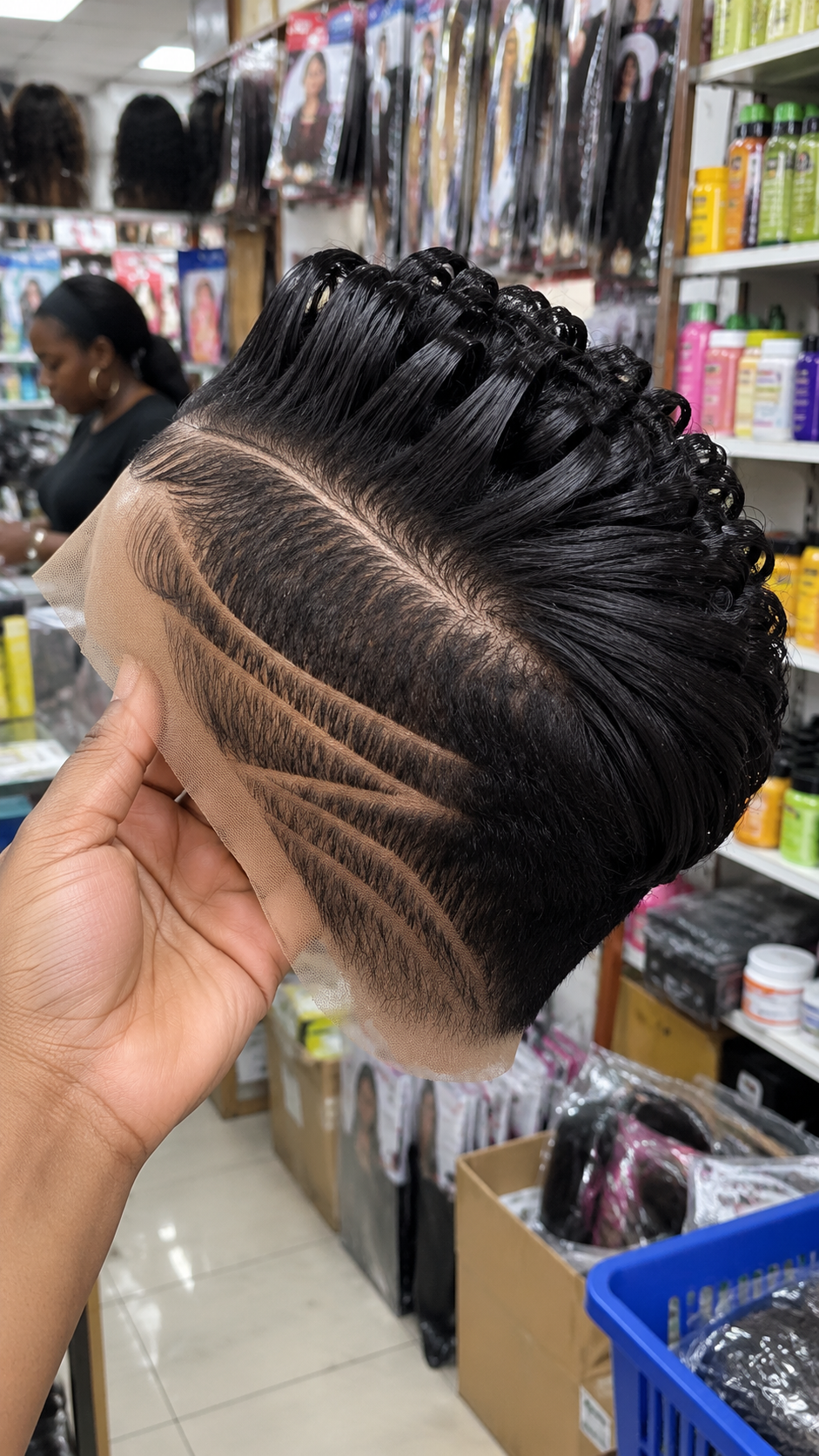
Not every precision-cut wig needs dramatic color contrasts to make an impression. Sometimes the most interesting craftsmanship appears in the direction of the strands, the spacing of the exposed channels, and the way the upper hairstyle progresses toward the back. This raven black lace wig presents an especially interesting example: elongated ribbon curls rise from the front, a sweeping parting separates the crown from the side, and three tapered carved channels create a feather-like arrangement across the lower panel.
The photograph captures the unit inside a busy beauty supply store before installation. A hand supports the wig from underneath, while an extended section of beige lace remains visible around the front and lower side. The upper hair reflects the store lighting in glossy black bands, revealing the direction of the individual strands. Unlike a conventional curly pixie, the crown is not composed primarily of small round coils. Instead, broad sections of hair rise into elongated bends, then progress backward into narrower loops and compact curled formations.
The most distinctive element, however, is the side design. Three narrow channels emerge beneath the main sweeping separation and travel diagonally across the darker hair. Their paths are not identical: the upper channel is longer, while the lower channels become progressively more compact. This creates a layered, feather-like visual effect that differs from ordinary parallel stripes or double crescent patterns.


For a buyer seeking this exact appearance, the side geometry should be considered before the final installation is planned. Its position, curvature, and remaining hair density all influence how the wig will look when fitted.
Reading the Feather-Like Carving From Front to Rear
The visible side contains a prominent sweeping parting beneath the upper hairstyle. Below that separation, the dark hair forms a broad, closely arranged panel. Within the lower portion of this panel, three narrow carved channels extend diagonally toward the rear-facing area.
The upper decorative channel travels the greatest visible distance. Beneath it, a second channel follows a related direction but begins and ends within a smaller area. The lowest channel is shorter again, contributing to the impression of a graduated feather pattern.
The channels appear lighter than the surrounding black hair because more of the underlying foundation is visible along their paths. Their tapered ends help distinguish the design from three full-length parallel stripes.
The dark sections between the channels remain clearly visible. This is important because the design depends on the alternating relationship between dark hair and exposed separations, rather than on removing large amounts of hair.
There are no clearly visible intersecting cross-lines or elaborate geometric shapes. The pattern is primarily directional, with several diagonal strokes that become shorter toward the lower side.
Why a Feather Pattern Requires More Precision Than Parallel Stripes
Parallel lines can often be planned around consistent spacing and direction. A feather-like pattern introduces additional decisions about length, taper, and the point where each channel terminates.
For this wig, the upper carved channel establishes the general direction. The smaller channels beneath it reinforce that movement without extending equally far across the side.
A custom maker should avoid turning all three into identical full-length lines. Doing so would change the visual progression and remove the graduated effect.
Similarly, excessively widening the channels could reduce the dark hair remaining between them. On a wig, that change may expose more foundation than intended and can be difficult to reverse.
Before cutting, a stylist should examine the reference at a close scale and agree on the number, relative length, and direction of the channels. An approval photograph of the side pattern is particularly valuable before the unit is shipped.
The Sweeping Crown Parting Organizes the Entire Upper Structure
Above the feather-like carving, a long exposed parting separates the elevated crown from the lower side hair. The channel begins near the front of the visible side and continues backward in a broad curve.
This separation serves a different purpose from the decorative channels beneath it. Rather than functioning primarily as barber artwork, it establishes the boundary between two areas with different styling directions.
Above the parting, the hair rises into broad ribbon-like sections. Below it, the strands lie much closer to the foundation, following a diagonal movement across the side.
The exposed channel also helps emphasize the contrast in hair density. The upper area contains more elevated strands, while the lower panel appears comparatively compact.
For a custom reproduction, the sweeping parting should be treated as a major structural detail. If it is positioned incorrectly, the entire relationship between the crown and the carved side may change.
How Cap Fit Can Alter the Parting Angle
A wig photographed while being held may look different when placed on a person’s head. The apparent angle of the parting depends partly on how the cap is positioned and supported.
If the cap is too large, the side may sit lower than intended. If it is too tight, the lace and hair arrangement may be placed under unnecessary tension.
Before making any permanent adjustments, the installer should confirm the intended wearing position and evaluate how the parting aligns with the temple.
A custom wig maker should also consider the wearer’s measurements before completing the side design. The carved channels should be planned around the final position of the crown separation rather than treated as an independent decoration.
Elongated Ribbon Curls Replace Ordinary Circular Ringlets
The upper hairstyle is particularly interesting because its curl construction changes along the visible crown. Near the front, broad strands rise into elongated bends. Farther backward, the sections become narrower and more closely grouped, eventually forming compact loops near the visible rear.
Several front sections resemble folded ribbons. The hair travels upward, bends backward, and returns toward the main body of the wig. These formations create visible openings, but they are generally longer and less circular than conventional spiral rings.
The glossy black strands are arranged in coordinated bands, making the direction of each section apparent. Some areas appear almost combed into broad curved sheets, while others show smaller loop openings.
This variation produces movement without requiring long hanging hair. The upper silhouette remains relatively compact, with the greatest height concentrated toward the front and central crown.
A buyer should therefore avoid requesting ordinary tight curls if the goal is to reproduce this design. The hairstyle relies on elongated, backward-moving ribbon sections rather than a uniformly coiled surface.
Controlling the Progression Toward the Visible Rear
The front-to-rear progression is one of the most important styling decisions. Large elevated sections at the front gradually transition into smaller curls toward the back of the visible crown.
If the same large loops are repeated across the entire wig, the rear may become excessively full. If the front sections are made too small, the hairstyle may lose its distinctive raised appearance.
For a custom order, ask the stylist to demonstrate how the ribbon sections change in size and direction across the crown.
A slightly elevated side photograph can reveal whether the front sections remain prominent and whether the smaller rear loops connect naturally to them.
The photograph does not show the complete back or nape, so the final rear arrangement should be confirmed separately rather than assumed.
Glossy Raven Black Without an Established Second Color
The visible hair appears predominantly raven black, with reflective charcoal tones along the raised surfaces. These lighter reflections are especially noticeable on the elongated ribbon sections, where broad strands catch the store lighting.
The recessed areas between the loops appear darker, creating contrast within the crown even though the hair uses one dominant color.
The side panel also appears black, although its closer strand arrangement produces a different reflective appearance from the elevated crown.
There is no clear evidence of deliberate silver, blonde, copper, or other colored highlights in the wig. The grayish reflections visible on some strands should not automatically be interpreted as a separate color treatment.
When ordering a comparable unit, a consistent deep black shade is more appropriate than introducing highlights that are absent from the reference.
What Shine Can and Cannot Tell a Buyer
The hair has a polished, reflective appearance, but shine alone cannot establish whether the wig contains human hair, synthetic fiber, or a blend.
Different materials and styling products can create similar reflections, particularly under bright retail lighting.
Ask the supplier to confirm the fiber material and explain which styling methods are compatible with it.
If the wig contains synthetic fiber, heat limitations should be verified before attempting to reshape the ribbon curls. If it contains human hair, previous processing and the original styling method may still influence how the hair responds to washing or heat.
The photograph does not establish any specific product coating, quality grade, or manufacturing origin.
The Lower Side Hair Is Part of the Design, Not Empty Space
Beneath the decorative channels, the wig retains a tapered section of dark hair. The strands appear closely arranged and become narrower toward the lower rear-facing edge.
This lower area provides visual weight beneath the feather-like pattern. Without it, the carved channels could appear disconnected from the rest of the side.
The hair is not completely shaved away. Fine dark strands remain visible over the foundation, particularly between and below the exposed channels.
A stylist recreating the design should preserve this coverage rather than removing the entire lower section.
The exact cutting technique cannot be determined from the photograph, but the visible result resembles a closely tapered side with decorative separations.
Why Excessive Cutting Can Damage the Proportions
Decorative cutting on a wig differs from cutting natural hair because the strands are attached to a constructed base. Removing too much hair can expose the foundation and may not be easily corrected.
The lower side already contains relatively close hair coverage. Additional cutting should therefore be considered only after the wig has been fitted and the existing pattern evaluated.
If the carved channels are visible and correctly positioned, further barber work may be unnecessary.
Any proposed adjustment should preserve the dark hair bands between the lines and the tapered lower section beneath them.
The Beige Lace Reveals an Unfinished Installation Stage
The photograph shows a broad section of beige lace extending beyond the front and lower side hairline. The mesh remains untrimmed, indicating that the wig has not yet been customized for an individual wearer.
Fine dark strands are visible near the front boundary, where the upper and side hair approach the lace.
The lace extends beneath the tapered lower section, creating a visible area of mesh around the side.
Its apparent beige color is influenced by the store lighting and the background beneath it. The final appearance against skin cannot be established from the photograph alone.
The image also does not confirm the exact lace grade, thickness, or manufacturing specification. It should not automatically be described as HD lace.
The complete interior cap is not visible, so the attachment system and adjustment hardware remain unconfirmed.
Questions to Ask About the Cap Before Installation
Request the cap circumference, front-to-back length, and ear-to-ear measurements.
Ask the seller for a complete underside photograph showing any combs, clips, adjustable bands, or straps.
Confirm whether the wig is designed for adhesive-free use. Visible lace does not independently establish that the unit is glueless.
For this hairstyle, the cap fit should be evaluated carefully because the sweeping parting and feather-like channels need to sit in suitable positions relative to the face.
Only after the fit has been confirmed should a qualified installer determine how much excess lace to remove.
Trimming too close to the hairline or carved side may damage the existing design.
Finding a Wig Maker for Ribbon Styling and Feather Carving
This hairstyle requires experience with two different techniques: sculpted ribbon curls and precision decorative side cutting.
When contacting a custom wig maker, send the reference photograph and describe the desired unit as a raven black swept-ribbon pixie lace wig with a long crown parting and three tapered feather-like side channels.
Ask whether the maker has previously created elongated ribbon loops rather than only conventional curls.
For the side pattern, request examples of decorative cutting performed on wigs. A barber experienced with natural hair may not necessarily understand the limitations of lace foundations.
Online wig marketplaces, independent custom wig makers, specialist lace wig boutiques, and local beauty supply stores are possible places to begin searching.
Exact availability and product specifications should be confirmed directly. A similar photograph in a listing does not guarantee that the delivered wig will match the reference.
Approving the Design in Stages
A custom commission should begin with agreement on the main elements: deep black coloring, elongated upper ribbon loops, a sweeping crown parting, and three graduated decorative channels.
Next, confirm the cap measurements, fiber material, and intended attachment method.
Ask whether the maker can provide photographs before completing the carved side pattern. This is particularly useful because cutting may be difficult to reverse.
Once the side design is approved, request final photographs showing the front, both sides, the back, and the complete underside.
For a local installation appointment, confirm whether the salon can perform lace fitting, hairline customization, ribbon adjustments, and any necessary barber work.
The safest sequence is to inspect the delivered wig, verify the cap fit, and complete permanent adjustments only after the intended wearing position has been established.
Illustrative Pricing for a Black Feather-Carved Ribbon Wig
The following USD amounts are broad illustrative planning ranges, not verified live prices for the photographed wig. Actual quotations may vary substantially according to supplier, location, material, cap construction, and styling labor.
| Wig Category | Illustrative USD Range | Potential Cost Considerations |
|---|---|---|
| Premium Custom | $345–$840+ | Individual construction, advanced ribbon styling, precision feather-like carving, and possible personalized fitting |
| Standard Custom | $185–$445 | Customized upper loop arrangement, selected cap options, sweeping parting, and specified side detailing |
| Basic Human Hair | $95–$265 | Base human-hair unit with potential additional charges for sculpted styling and decorative cutting |
| Premium Synthetic | $65–$195 | Pre-styled ribbon loops, cap specifications, and fiber-dependent maintenance limitations |
| Basic Synthetic | $30–$105 | General black pixie resemblance, simpler construction, and potentially less accurate ribbon or feather details |
These categories represent possible purchasing alternatives. The photograph does not establish whether the wig contains human hair, synthetic fiber, or a blend.
Because the hairstyle uses one dominant black color, the main cost consideration may be the labor involved in arranging the elongated loops and creating the graduated side channels.
A basic black pixie wig may be relatively straightforward to purchase, but reproducing the raised ribbon structure and feather-like carving can require additional professional work.
Cap customization, lace fitting, installation, shipping, taxes, and barber services may not be included in the advertised price.
Ask for an itemized quotation that identifies the base wig cost and any separate styling or installation charges.
Care Priorities for the Ribbon Crown and Feather Pattern
The upper hairstyle depends on keeping the elongated loops in their intended positions. Aggressive brushing or repeated pulling could separate the strands and reduce the height of the raised sections.
Before washing or restyling, ask the supplier how the loops were created and which products are compatible with the actual fiber.
Synthetic hair may have restrictions involving heat and certain styling products. Human hair may permit different treatments, but its processing history and the original styling method still matter.
Do not attempt to restore flattened loops using high heat until the material and its temperature limitations have been confirmed.
Heavy product buildup may also cause neighboring strands to stick together, reducing the visibility of the individual ribbon formations.
Protecting the Graduated Side Channels
The feather-like design should be maintained carefully because its appearance depends on the relative length and spacing of the three channels.
If nearby strands begin covering the separations, a stylist should first assess whether repositioning can restore their visibility.
Repeatedly widening the channels may permanently alter the pattern or expose excessive foundation material.
When storing the wig, use an appropriately sized support that does not compress the upper loops or stretch the cap.
Avoid folding the lace sharply across the lower side, as this could place unnecessary stress on the mesh and nearby hair.
Final Quality Checks for a Faithful Reproduction
A successful custom version should be evaluated through the relationship between the upper and lower sections rather than through the overall silhouette alone.
The crown should contain elongated, glossy black ribbon loops that rise from the front and sweep backward. The loops should remain recognizable without creating excessive height or fullness.
The side should contain a prominent sweeping parting above three graduated feather-like channels. The decorative lines should become progressively shorter while preserving dark hair between them.
The lower section should retain visible hair coverage and follow a tapered path toward the rear.
The color should remain predominantly deep black, with any lighter reflections arising naturally from the hair surface and lighting unless the buyer specifically requests additional coloring.
Finally, the cap measurements, lace specifications, and attachment method should be confirmed before permanent trimming or installation.
The defining quality of this wig is its combination of elongated crown styling and graduated side geometry. The raised ribbon loops create movement above, while the feather-like channels introduce a distinctive pattern below. Preserving the direction, spacing, and proportions of those elements produces a more faithful result than adding extra curls, unnecessary highlights, or unrelated decorative stripes.
Search Terms
raven black ribbon curl lace