
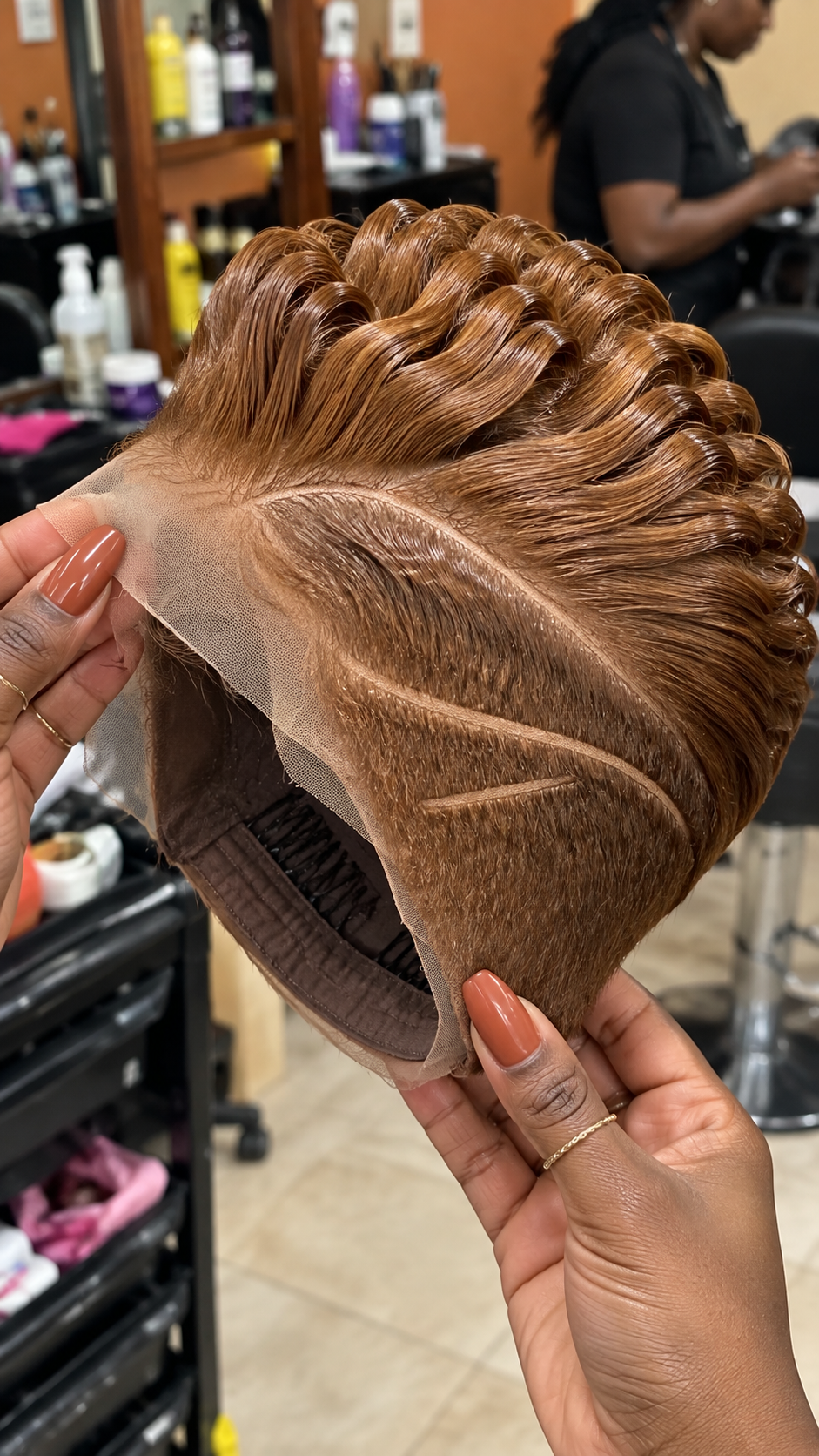
Golden caramel color gives this sculpted wig an entirely different personality from darker black, burgundy, or deep copper designs. The shade is carried across the complete unit, including the raised looped crown and the close side area, so the eye is drawn first to the movement of the hair and then to the sweeping carved detail below it. Instead of depending on several contrasting colors, this piece uses one warm tonal family and lets shape, spacing, direction, and shine create dimension.
The photograph also gives a valuable pre-installation view of the construction. Lace extends beyond the perimeter, the interior cap can be seen underneath, and the side design has already been formed before fitting. For someone shopping for a customized wig, those details matter because this is not simply a ready-made hairstyle that depends on styling after purchase. The placement of the crown loops, the long side separation, and the smaller accent line all need to be planned as parts of the same composition.
One of the strongest aspects of this unit is the relationship between the golden caramel color and the large sculpted sections. Light travels along each loop from root to bend, creating naturally darker valleys between the raised pieces. The result is dimensional even though the wig does not rely on obvious contrasting streaks. It is an excellent example of how a carefully selected single-color palette can still produce substantial visual depth.
Golden Caramel Gives the Sculpted Crown Its Character
The color sits between golden brown, caramel, and honey tones rather than leaning strongly toward bright blonde. This distinction is important when discussing a recreation with a wig maker. A generic request for “blonde” would not accurately describe what is visible here, and a bright yellow-gold interpretation would change the entire mood of the piece.
The deeper areas between the loops appear slightly richer because less light reaches them, while the outer curves reflect a brighter golden tone. That variation comes largely from the three-dimensional styling rather than from obvious bands of separate colors. Under different lighting, the same unit could therefore appear somewhat deeper or lighter without the actual hair color changing.
Anyone ordering a similar shade should send the reference photograph and discuss the intended warmth with the colorist. Ask whether the proposed color leans honey, caramel, golden brown, or light auburn. Viewing a sample under neutral lighting can prevent a finished wig from becoming much more yellow or orange than expected.
The Upper Hair Moves in a Continuous Sculpted Sequence
The crown is arranged through broad looped sections that travel from the front toward the rear. They are not isolated ringlets. Each piece has enough width to show the direction of the strands clearly, creating the appearance of folded ribbons moving across the head.
The front sections rise prominently before bending backward. As the pattern progresses, the loops begin to overlap and settle closer together. This creates a controlled transition from height near the front into denser movement toward the rear. The silhouette therefore gains presence without requiring extreme length.
The spacing is particularly important. Small gaps between neighboring loops allow each section to remain readable. If the hair were packed into one continuous mass, much of the sculptural effect would disappear. On the other hand, separating the loops too widely would expose too much of the foundation and break the visual rhythm.
A stylist recreating the look should work from the overall direction first and refine individual loops afterward. The most convincing result comes when all sections appear to belong to one flowing sequence rather than looking like separate curls placed independently across the crown.
A Long Side Division Controls the Proportions
Beneath the crown is a strong sweeping division that separates the raised hair from the close side panel. It begins toward the frontal area and travels backward in a long arc. This boundary is responsible for much of the wig’s visual balance because it establishes exactly where the upper volume ends and the side artwork begins.
The line is neither completely straight nor aggressively circular. It follows a stretched curve that complements the direction of the loops above it. That relationship makes the side appear connected to the crown instead of looking like a separate barber design added afterward.
For a custom order, the size of the upper side panel should be discussed together with the placement of this curve. If the separation is positioned too high, the close panel can dominate the design. If it sits too low, the carved work may become difficult to see once the wig is installed. The reference maintains a generous central panel while leaving enough lower space for the second detail.
The Smaller Accent Line Adds Detail Without Crowding the Side
Inside the lower section is a narrower carved line that follows part of the larger curve. It does not attempt to duplicate the entire outer shape. Instead, it begins farther back and creates a smaller directional accent. That difference in length gives the side design hierarchy: the larger sweep remains dominant while the inner mark acts as a supporting detail.
This is one of the reasons the side does not feel overloaded. There are visible carved elements, but they are not competing for attention. The upper loops remain the primary focal area, followed by the long division, with the smaller accent discovered afterward.
When showing this reference to a barber or wig stylist, point out that the two lines should not simply become equal parallel stripes. Their different lengths and positions are part of the design. Maintaining that distinction will keep the side closer to the reference.
The Close Side Panel Makes the Crown Appear Taller
Another important visual technique is the contrast in density between the crown and the side. The upper sections rise away from the cap, while the side stays extremely close. This difference exaggerates the height of the loops without requiring the crown itself to become excessively large.
The close area also provides a quieter surface for the carved lines. If curls or longer strands occupied the same space, the pattern would become difficult to read. Keeping the side compact allows the negative space of the carving to remain visible from a three-quarter angle.
For clients who like dramatic crown styling but do not want long hair around the face and neck, this type of proportion can be particularly appealing. It concentrates the visual interest upward while keeping the lower silhouette compact.
The Visible Lace Tells Buyers What Still Needs to Be Done
The lace has intentionally not been trimmed in the photograph. That makes the image useful for understanding the wig before installation. The lace extends around the front and side perimeter, while the interior cap is partially visible beneath it.
What cannot be established from the photograph is the exact commercial grade of that lace. Buyers should therefore avoid assuming a particular specification and ask the seller directly about lace material, color, coverage, and customization options. If tinting is required, that should also be discussed before the installation appointment.
The final result will depend on where the unit is positioned before trimming. With a wig containing carved side artwork, placement has consequences beyond the front hairline. Moving the unit too far forward, backward, upward, or downward can change where the long curve sits around the temple and ear.
For that reason, the lace should not be cut simply by copying its current outer edge. A professional fitting allows the installer to establish the correct position first and remove only the necessary excess afterward.
Cap Construction Matters More With Sculpted Designs
The interior visible in the image suggests a structured wig base rather than loose hair being held temporarily for display. For a buyer, cap fit becomes especially important because the crown has already been shaped into a specific arrangement.
A unit that is too large may shift and disturb the intended location of the side curve. One that is too tight may sit higher than expected or feel uncomfortable during extended wear. Accurate circumference and front-to-nape measurements are therefore valuable, but customers should follow the exact measuring instructions supplied by their wig maker because construction methods can differ.
Before ordering, ask whether the cap has adjustable components and whether any internal combs, bands, or other securing elements are included. The photograph reveals part of the interior, but it does not establish every construction specification. Those details should come directly from the maker.
Who Should Handle the Final Customization?
This is the type of wig that benefits from cooperation between a wig stylist and a barber experienced with precision side work. The crown requires someone who understands sculpted hair direction, while the side design requires control over spacing and proportion.
If the unit arrives with the carving already completed, the installer should concentrate on preserving it rather than automatically reshaping the area. If further adjustment is necessary, it should be done only after the wig has been fitted on the wearer. Altering the side while the unit is off the head can make it difficult to predict where the design will ultimately sit.
When booking an appointment, send the stylist a photograph beforehand and explain that the wig contains pre-shaped crown work and a carved side panel. This gives the salon an opportunity to confirm whether it regularly works with this type of customized unit.
Ordering From a Wig Maker Without Losing the Reference
A good custom order starts with a visual specification rather than a vague hairstyle name. Send clear photographs showing the crown, side, front perimeter, and interior whenever they are available. For this particular piece, identify the golden caramel color, broad backward-moving loops, sweeping side division, close lower panel, and smaller interior accent line.
Next, confirm the practical details separately. Ask about hair material, density, cap sizing, lace type, lace color, processing time, and whether the styling shown in the seller’s photographs is included in the quoted price. Some sellers charge separately for coloring, carving, or final styling.
If you are ordering online, request photographs of the actual completed unit before shipment when the seller offers that service. The side angle is especially important. It allows you to compare the position of the long curve and the smaller accent with the reference rather than discovering major differences only after delivery.
Maintaining the Loop Pattern After Purchase
The crown should not be treated like loose everyday hair. Aggressive brushing can separate the grouped sections that create the ribbon-like effect. Maintenance should focus on preserving the direction and spacing established by the stylist.
Product choice depends on whether the unit is made from human hair, synthetic fiber, or another material. Use only products and heat levels appropriate for the actual construction. If the wig maker supplies care instructions, those instructions should take priority over generic online advice.
Storage is also important. The crown needs enough open space that the raised sections are not pressed downward. A suitable wig stand can help maintain the silhouette between wears. Before storing the unit, allow any styling product or moisture to settle according to the maker’s recommendations.
The carved side area requires relatively little manipulation compared with the crown, but friction should still be minimized. Repeated rubbing against storage surfaces can disturb the close fibers and make the carved separation less crisp over time.
Photographing the Wig for a Business Listing
For sellers, the strongest product photography should explain the construction rather than merely show the color. A three-quarter view like the reference captures the golden caramel crown, the lace perimeter, the close side panel, and both carved elements simultaneously.
A second image from slightly above can reveal the sequence of the loops. A direct side angle can document the sweeping curve, while an interior photograph can show the cap and adjustment system. These views answer different customer questions and can reduce uncertainty before purchase.
Color accuracy is particularly important with golden caramel shades. Extremely warm lighting can make the wig appear more orange, while cool lighting may reduce its golden character. Sellers should avoid heavy color manipulation if customers will be ordering based on the photographs.
Choosing Between an Exact Recreation and a Personalized Version
Some customers will want the reference copied as closely as possible, while others may only want its general idea. Decide this before production begins. For a close recreation, preserve the golden caramel family, broad crown loops, elongated side curve, smaller interior line, and compact lower silhouette.
For a personalized interpretation, one element can be changed while the others remain recognizable. A slightly deeper caramel tone, for example, would alter the color without destroying the architecture. Changing the crown direction, side pattern, color, and proportions at the same time would result in a substantially different wig.
A consultation is the best place to decide which details are essential. Bring the reference, discuss the intended use, and ask the stylist what can realistically be recreated on the chosen cap and hair material.
Custom Wig Price Guide
Pricing for a piece like this depends heavily on hair material, coloring, cap construction, lace coverage, crown shaping, side customization, and the experience of the person producing it. The figures below are broad reference ranges rather than quotes for the exact wig shown.
| Category | Estimated Range | What Can Affect the Price |
|---|---|---|
| Premium Custom | $500–$980+ | Higher-grade hair, custom golden caramel coloring, individual measurements, sculpted crown work and detailed side customization |
| Standard Custom | $310–$500 | Custom sizing, lace construction, warm caramel coloring and professional crown shaping |
| Basic Human Hair | $190–$330 | Hair quality, density, lace area, color processing and additional styling work |
| Premium Synthetic | $115–$210 | Fiber grade, heat tolerance, cap quality and amount of pre-styling |
| Basic Synthetic | $65–$125 | Fiber type, cap construction, lace coverage and available customization |
Before Paying the Final Balance
Review the completed unit from several angles rather than judging it only from the front. Check the warmth of the golden caramel shade, the height of the first crown loops, the backward progression of the remaining sections, the length of the primary side curve, and the position of the smaller accent line.
Confirm the cap measurements and lace specification with the seller, then arrange installation with someone who understands customized lace units. If possible, avoid trimming or changing the side work yourself before the first fitting. Once material or hair has been removed, restoring the original proportions can be difficult.
This wig succeeds because its details support one another. The warm golden caramel shade emphasizes the raised crown, the broad loops create directional movement, the close side panel provides contrast in height, and the two unequal carved lines give the lower area its identity. Preserving those relationships is the key to obtaining a result that stays faithful to the reference while still fitting the individual wearer properly.
Search Terms
golden caramel sculpted wig · honey brown ribbon loop wig · sweeping side curve wig · golden brown lace wig · caramel loop crown wig · curved accent line wig · warm honey sculpted hair unit · golden caramel carved side wig