
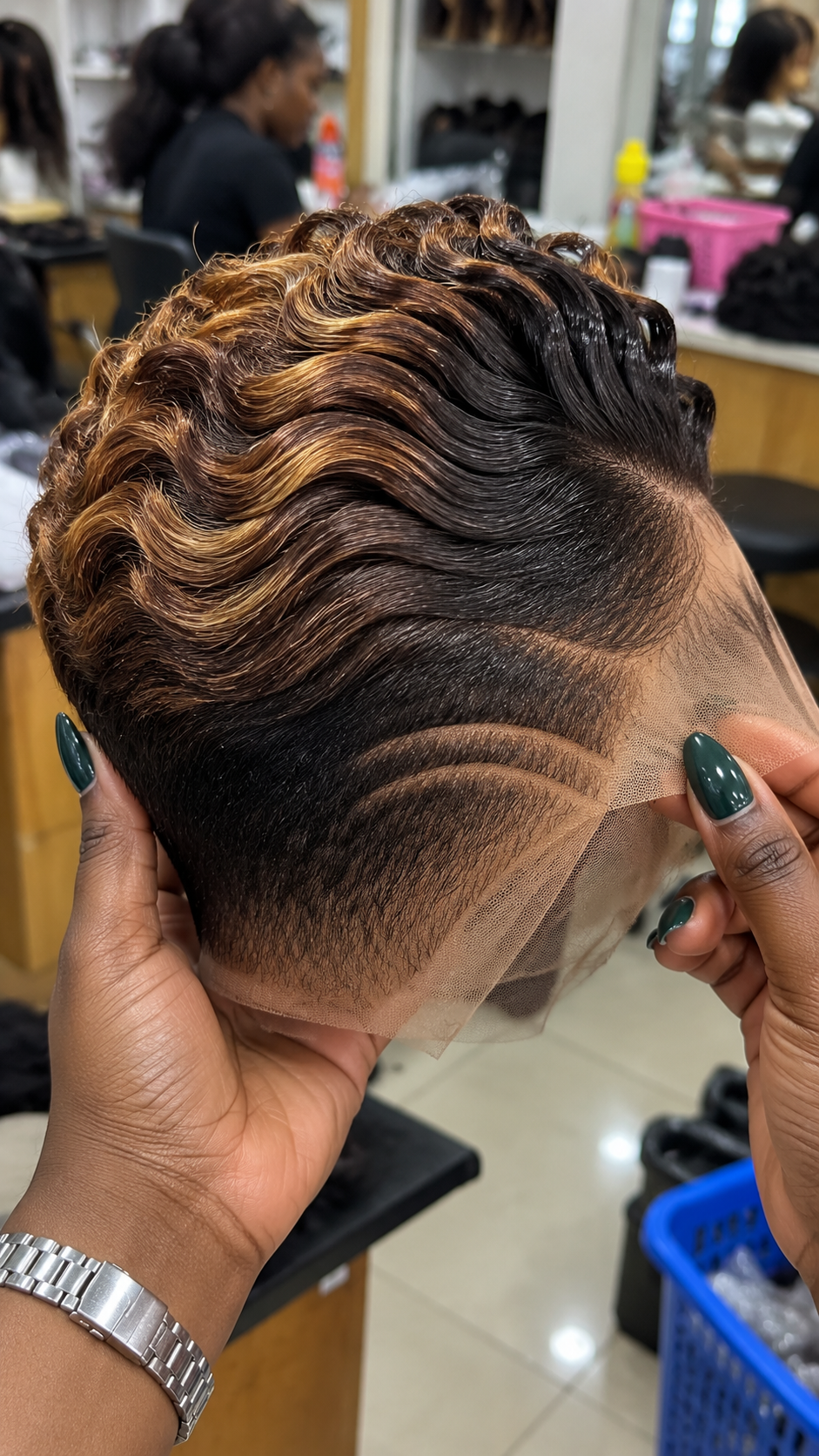
The final reference combines honey-copper brightness, chestnut depth and a small oval side accent that distinguishes it from the other versions. It is decorative without being random: the color, loop scale and side motif all have specific roles that should be written into a custom order.
Honey brightness works because chestnut stays underneath
The warmest reference in the set uses honey-copper light over a deeper chestnut foundation. The darker base keeps the raised loops from looking flat and gives the side panel enough contrast to remain readable. A custom color plan should therefore protect the chestnut depth at the roots and in the recessed areas. If every strand is lifted to the same gold tone, the unit loses the dimensional effect that makes the crown look sculpted.
The oval accent is a true design feature
The small oval element on the side is not random decoration. It interrupts the parallel lines and gives this version a recognizable signature. A maker should map its size, angle and distance from the main part before finishing the surrounding lines. If the oval becomes too large, it dominates the panel; too small, and it disappears. Include a close crop of this motif in the order notes and ask for a direct side-view approval image before shipment.
Raised loops should transition into smaller rear detail
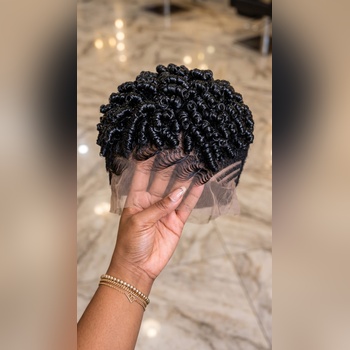
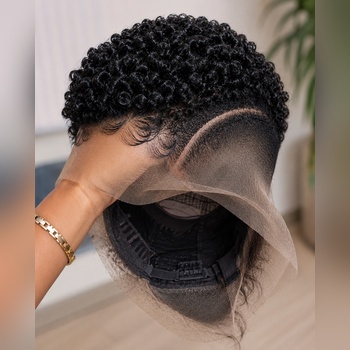
The front and upper crown use larger lifted sections, while the back becomes more compact. This transition controls the profile and prevents the warm color from creating too much apparent volume. A stylist should evaluate the silhouette from the side as the loops are formed. The goal is a crest that rises and then settles, not a uniform wall of curls. Clients with smaller head proportions may need the loop scale reduced while keeping the same front-to-back progression.
Honey tones should be approved beside neutral white
Warm salon walls and gold mirrors can make honey hair look richer than it is. Ask for one approval photo beside a neutral white or gray surface. That image becomes the reliable color reference for both client and stylist. Social-media photos can use warmer décor later, but the order itself should be based on a neutral-light record. This is particularly useful when the unit combines chestnut, copper and honey, because those three tones can merge under yellow lighting.
The side panel needs its own aftercare routine
Graphic side work can soften from friction before the crown loses shape. At home, avoid rough scarf edges and tight headwear that rub repeatedly over the motif. At a salon refresh, clean the area gently and re-establish the visual separation around the lines without overworking the lace. The crown may need only selective loop reshaping. Treating the two zones differently preserves the original balance and prevents unnecessary manipulation of the highlighted hair.
Offer the motif as a documented customization
For business use, photograph the oval-and-line design clearly and give it a specific internal service code or description. That way a returning client can request the same side treatment without relying on memory. The color, cap and loop scale can still be adjusted for a new order. Documenting the motif turns a one-off visual idea into a repeatable salon service while keeping each client’s color combination and fit individual.
Writing the oval motif into the order
For the honey-copper unit, bring a close crop of the oval motif as well as the full reference. Confirm its size, the spacing of the three accompanying lines and the point where the honey tone becomes strongest on top. Because the design has several recognizable details, a written order summary is worth the extra minute before a deposit is paid.
Remote checkpoints for the oval version
The honey-copper order should include a close proof of the oval accent before shipment. Ask for the line spacing, top loop scale, rear transition and color balance in separate images if necessary. A single photo cannot prove all of those details. Save the approved images so a future replacement unit can be compared to the same specification.
Two-zone care for honey copper
Honey-copper loops and the graphic side should be treated as two maintenance zones. Protect the highlighted crown from heat and friction, while keeping the oval-and-line motif free from buildup. A salon refresh can address whichever area has softened first instead of disturbing the entire unit.
Cost Guide for Honey-Copper and Oval Detail
| Option | Typical Range (USD) | Planning note |
|---|---|---|
| Premium Custom | $320–$520+ | High-grade hair, advanced color or detailing, fitting and precision shaping |
| Standard Custom | $220–$320 | Salon-built unit with controlled styling and moderate customization |
| Basic Human Hair | $150–$230 | Human-hair base with simplified finishing |
| Premium Synthetic | $95–$170 | Quality fiber with pre-shaped form and selected custom work |
| Basic Synthetic | $55–$95 | Entry interpretation with fewer custom stages |
These figures are planning ranges rather than fixed retail prices. Final cost depends on hair material, cap construction, color processing, labor, fitting and the complexity of the visible side work. Ask for a written breakdown before paying a non-refundable custom deposit.
Search Terms for the Honey-Copper Reference
honey copper wig · oval side accent wig · three line side design · chestnut loop wig · golden copper highlights · raised loop crown · lace perimeter hairpiece · custom graphic wig
Final honey-copper standard
For the honey-copper version, the oval accent is the final signature. Keep it proportionate, protect the line spacing and let the warm crown remain the counterpoint.
Chestnut depth at the root
Before paying the balance, ask to see the inside cap and confirm the exact adjustment system, cap circumference and lace specification. The exterior reference is built around honey-copper raised loops, but comfort depends on what is underneath. A cap that is too large can rotate and move the oval accent joined to three lines out of position; one that is too tight can distort the front edge. Record the measurements on the invoice so a future remake starts from verified fit data rather than memory. If the seller cannot confirm a technical detail, leave it out of the public product description instead of guessing.
Measuring the oval motif
If another stylist will maintain the unit later, give that person a short technical brief. Note the chestnut with honey-copper palette, the direction of the part, the scale of honey-copper raised loops and the location of the oval accent joined to three lines. Include two or three unfiltered reference photographs. This is more useful than simply saying “make it like before,” because a sculpted wig can change quickly when a new stylist interprets the loops differently. A written brief also prevents accidental changes to the side design during a routine refresh.
Honey tone under neutral light
For social content, shoot one image that prioritizes construction rather than glamour. Use neutral light, keep the camera close enough to show the part and oval accent joined to three lines, and include a second angle that reveals honey-copper raised loops. Then capture a wider salon image for context. This combination gives buyers both proof and inspiration. Avoid filters that shift chestnut with honey-copper, because the post may later be used as a color reference by a customer. Accurate images reduce repetitive questions and make the article’s search terms match what people can actually see.
Protecting the side from friction
Before wearing the unit for a long event, test it for at least an hour at home. Check pressure near the ears, movement at the nape and whether the sculpted top changes when the wearer turns the head. The oval accent joined to three lines should remain in its intended position without over-tightening the cap. If adhesive will be used, follow the product instructions and do not make the event day the first fitting. A short wear test gives time to correct comfort or placement issues while the lace and styling are still easy to adjust.
Creating a repeatable salon signature
If this design is remade, protect its identity by deciding which elements are fixed and which can change. Keep the part direction, the relationship between honey-copper raised loops and the side, and the recognizable oval accent joined to three lines. Color within the chestnut with honey-copper family can be adjusted for the client, and loop scale can be tuned for head size. Treat those as controlled variations rather than redesigning every feature at once. This approach creates a recognizable salon signature while still allowing each order to feel personal.
Replacement-order specification
At collection, inspect the unit in ordinary light before leaving the salon. Look at the part from above, check the oval accent joined to three lines from a true profile, and make sure honey-copper raised loops remains separated rather than compressed. Confirm care instructions for the actual hair material and ask when the first maintenance visit should happen. Take one final photo of the finished unit on the wearer or a correctly sized head form. That image becomes the baseline for future refresh work and makes any later change in shape or color easier to diagnose.