
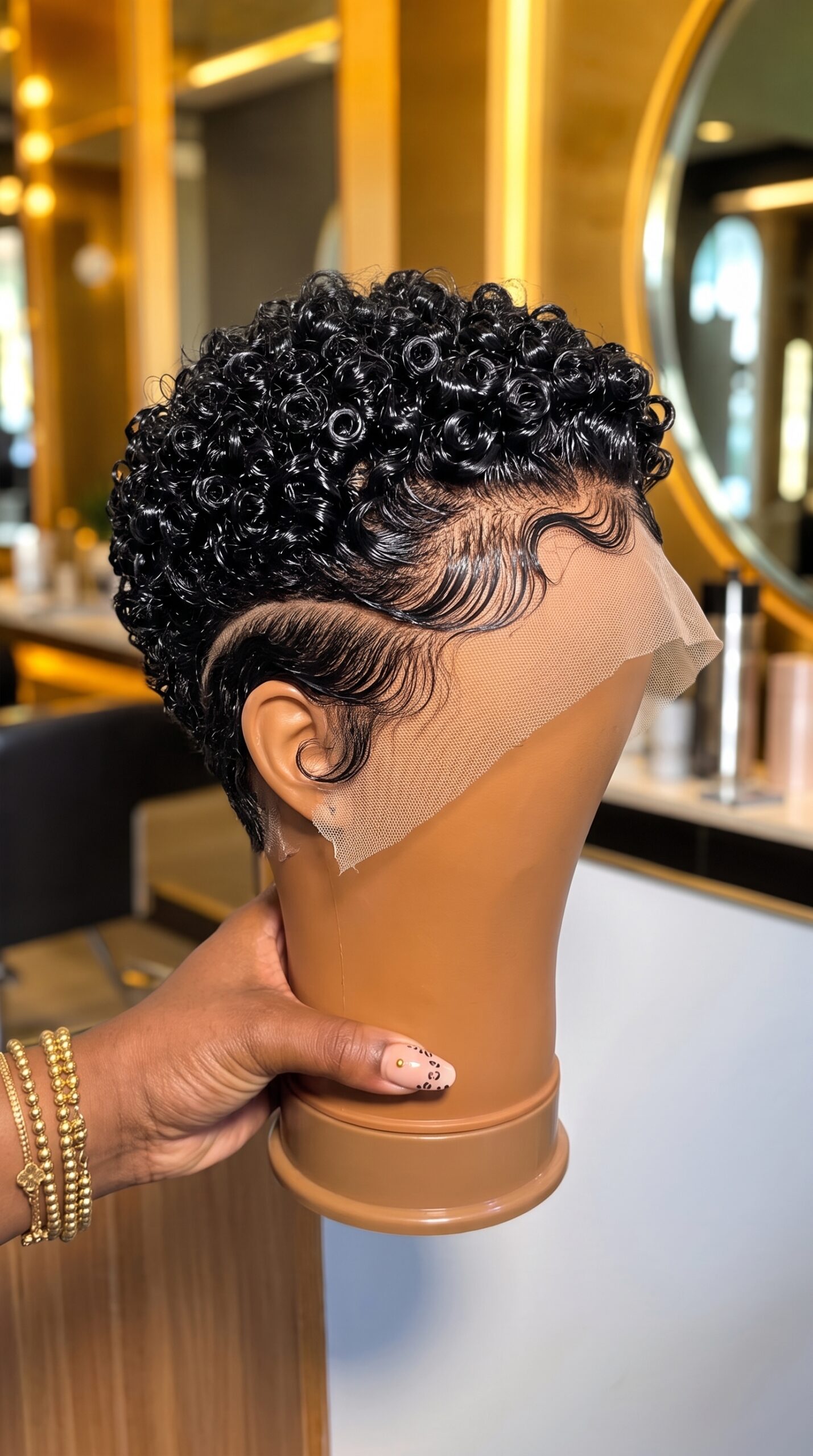
Most short units stop the lace at the temple. This one carries it down past the ear, and that single difference is what lets the finger waves sweep back instead of forward.
On this black curly pixie wig the crown is a set of tight spiral curls, and along the side the hair is smoothed into deep finger waves that flow down and curl at the ear. The lace does not end where the waves begin. It continues past the ear onto the block, which means the waved section is knotted on lace, not sitting on a cap edge. That is what makes a swept-back style possible on a short unit.
Where To Buy A Wig Like This
Lace that extends down the side is a specific build, and it is the difference between a piece you can only wear forward and one you can push off the face.
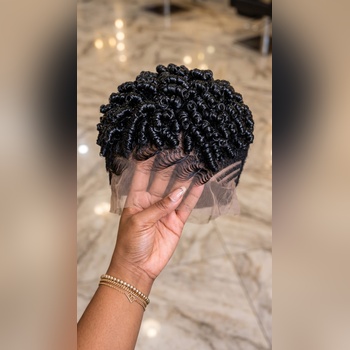
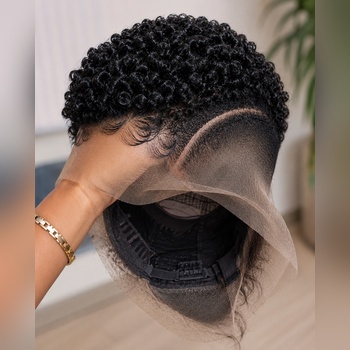
Custom makers and lace studios. The route that can extend the lace to suit how you want to wear it. One or two people working to order over WhatsApp or direct message, four to six weeks, deposit up front. Worth it because the side lace is what lets the waves sweep back, and only a maker building to order decides how far it runs.
Instagram and TikTok sellers. The widest choice. Search the terms below plus your city, and look for a video where the side is swept back, since that is the only way to see whether the lace reaches past the ear or the waves are just laid forward over a cap edge. A maker showing only forward styling may be hiding a short lace.
Etsy. Workable for made-to-order, usually silent on how far the lace extends. Ask before ordering and read buyer photographs of the side.
Marketplaces such as Amazon, AliExpress and Temu. Cheap synthetic pieces here almost always stop the lace at the temple, because extending it is hand work that does not fit the price. Fine for a forward style, not for anything swept back.
Local beauty supply shops and salons. Useful for checking how far the lace runs before paying, which is hard to judge online. Prices run about a third above online. Some salons order custom and fit it.
Vendor or wholesale direct. Minimums of five to ten identical units, relevant only for resale.
Regional note. Independent makers doing extended-lace short units are concentrated in Nigeria, Ghana, South Africa, the United States and the United Kingdom, with the busiest Instagram communities in Lagos, Accra, Atlanta and London. Ordering internationally adds shipping and duty to the comparison.
Vetting a seller. Continuous posting history rather than a burst. A photo or video of the side swept back. Buyer photographs on request. A specific answer on how far the lace extends. Returns position in writing.
Red flags. Only ever showing the waves laid forward. The same image across several shops. No answer on side lace. A price well under the ranges below for extended-lace human hair. Payment only by irreversible transfer.
What to send when you enquire. A reference photograph, your head circumference, your crown-to-nape measurement, which side the waves sit on described by ear, whether you want to wear the side swept back, and your deadline.
Paying safely. Thirty to fifty percent deposit, balance before shipping. Ask for a photograph of the side with the lace visible, not laid over, before releasing the balance.
Contact / Order Inquiries: WhatsApp is where most independent makers take orders. [WhatsApp: +XX XXX XXX XX XX] — ask how far the lace extends down the side and whether the waved section can be worn swept back.
Why The Lace Has To Reach Past The Ear
A finger wave that sweeps back and down needs hair knotted along the whole path it travels. If the lace stops at the temple, the hair stops there too, and the wave can only be laid forward over the edge, hiding where the cap ends.
Extend the lace past the ear and the waved hair is knotted all the way down. Now it can sweep back off the face, curl at the ear, and there is still lace and hair where a cap edge would otherwise show. The style that looks effortless in the photo is only possible because the lace went further than usual.
This is the same reason a frontal lets you push hair off the face and a closure does not. Here it applies to the side rather than the front, and it is what separates a swept side from a forward-only one.
What The Extended Lace Costs You Elsewhere
More lace is more to trim, and the side is harder to trim than the front.
Front lace you can see in a mirror. Side lace past the ear sits where you cannot easily watch your own hand, and the curve around the ear is the hardest line to cut cleanly. This is worth knowing before you buy, because the build that gives you the swept style also gives you a harder first trim.
Have the side trimmed by someone else the first time, and keep the shape to copy later.
Judging The Waved Side
The finger waves here run down the side and curl at the ear. Judge them on whether each ridge holds the same depth along its length, and whether the wave direction flows down consistently rather than breaking partway.
Check where the lace sits relative to the waves. On a well-built piece the waved hair is knotted on lace right down to where it curls at the ear, so the whole side reads as growing. If the lace stops higher and the lower waves sit on a cap edge, the side can only be worn one way.
The waves are product-set and wash out. The knotting and the lace extent are what last and what you are paying for.
How Much It Costs
Extended side lace adds hand-knotting and prices above a temple-stopped build.
The unit itself
Human hair black curly pixie wig, lace extended past the ear, finger waved side, sheer lace, glueless cap: $260–$540
The same curly pixie wig with lace stopping at the temple, waves laid forward only: $210–$430
Human hair pixie wig, no waved side, standard lace: $170–$350
Quality synthetic curly pixie wig with extended lace: $80–$165
Basic synthetic short curly wig, temple lace: $25–$60
The gap between the first two lines buys the extra lace and the knotting down the side. It is what makes the swept style possible and is invisible until you try to wear the side back.
What is usually included, and what is not
Included in most quotes: cap, hair, standard knotting, standard lace to the temple.
Charged separately by many makers: extending the lace past the ear ($20–$50), HD or fine lace over standard ($20–$50), bleached knots across the full lace ($15–$40), fine-hair edges ($20–$50), pre-trimmed lace ($25–$50), rush build ($40–$100).
Ask whether the extended side lace is inside the number. A piece quoted as standard lace may stop at the temple.
Shipping and duty
Tracked international shipping on a single short unit generally runs $25–$60. Import charges vary by country on declared value; allow ten to thirty percent of the item price and check your own rates.
The costs that come after
Canvas block and stand: $25–$60 once
Satin cover: $5–$15
Edge and wave setting products: $15–$40 per year
Colour-safe wash products: $20–$40 per year
Professional first lace trim: $40–$90 once, higher than usual because the side past the ear is harder to cut
Professional reset of the waves and curls: $40–$90 per visit, two to four times a year
First year, all in
A mid-range human hair version at $360, plus $45 shipping, plus roughly $60 duty, plus $50 of storage kit, plus $45 in products, plus one $70 trim and two $60 resets, comes to around $750 across twelve months.
The synthetic equivalent at $130 with no resets comes to around $190.
Cost per wear
Worn three times a week over a year, the human hair piece lands near $4.80 per wear and carries into a second year. The synthetic sits near $1.25 per wear but the waves soften inside twelve months.
What an unusually low price means
Extended-lace human hair with a knotted waved side is hard to produce under about $140. Below that the lace almost certainly stops at the temple and the waves are laid forward over a cap, or the piece is a fibre blend.
Deposit structure
Thirty to fifty percent up front, balance before shipping. Ask for the side photograph with the lace visible before releasing the balance, since a laid-forward wave in a finished shot hides whether the lace runs past the ear.
Before You Pay
How far does the lace extend down the side?
Can the waved section be worn swept back, or only forward?
Can you show me the side with the lace visible, not laid over?
Are the knots bleached along the extended side lace?
Does the wave keep its depth all the way to the ear?
Trimming The Lace
Work along your own hairline with short angled cuts, leaving a margin rather than trimming flush.
The side past the ear is the hard part on this build. The curve around the ear is difficult to cut cleanly and you cannot easily see your own hand there. Have someone else do the side on the first trim, and photograph the finished shape so it can be copied.
Have the whole first cut done by someone experienced if you have not trimmed lace before.
Search Terms
finger wave pixie wig · black curly pixie wig human hair · extended lace side pixie wig · swept back pixie wig · lace past ear short wig · curly pixie wig with waved side · finger wave short wig where to buy
Final Thoughts
The reason this piece can be worn swept off the face is not the wave, it is the lace underneath it running past the ear. Most short units stop at the temple and can only be worn forward. The extra lace is invisible in a photo and is exactly what you are paying the difference for.
Ask how far the lace extends and to see the side with the lace showing. If it stops at the temple, the swept style in the photo is the only styling the piece will ever do, laid forward and no other way.