
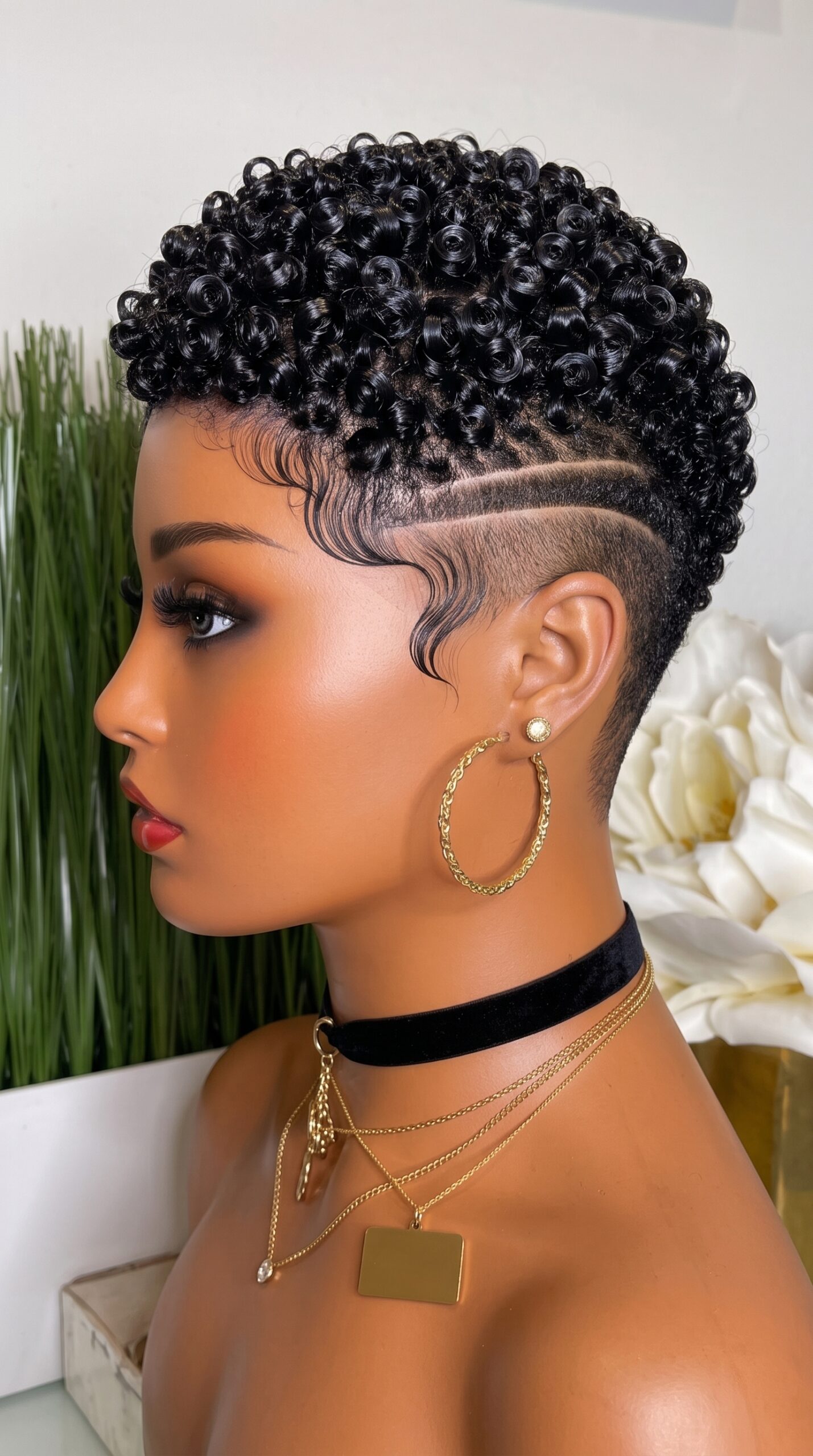
Cover the edges with your thumb and this becomes an ordinary curly pixie. The swirled baby hairs at the temple are what make it read as growing from the head.
On this black curly pixie wig the crown is a set of tight glossy curls, the side drops through a carved fade with a single line, and along the front the edges have been laid into fine sculpted swirls that curl down past the temple. The curls are the product. The edges are the illusion, and the illusion is the harder thing to buy.
Where To Buy A Wig Like This
Laid, swirled edges are a knotting and styling skill combined, and they are the detail most often faked with a photo and product for the shot.


Custom makers and lace studios. The route for edges knotted from genuinely fine hair. One or two people working to order over WhatsApp or direct message, four to six weeks, deposit up front. Worth it because the edge is where a short unit passes or fails as real hair, and only a maker building to order chooses the right hair for it.
Instagram and TikTok sellers. The widest choice. Search the terms below plus your city, and look at edge close-ups in stills, since swirled baby hairs either flow from fine knotted strands or are painted on with product for one photograph. Ask for an edge photo taken before styling, dry and unlaid, which shows what hair is actually there.
Etsy. Workable for made-to-order, but edge quality is rarely a strength and stock photos oversell it. Buyer photographs show the edge as it arrives, which is what matters.
Marketplaces such as Amazon, AliExpress and Temu. Cheap synthetic pieces here usually have edges made from the same fibre as the crown, too thick to swirl convincingly. Fine at the price for the overall look, not for a realistic hairline.
Local beauty supply shops and salons. Useful for seeing whether the edge is genuinely fine hair before paying. Prices run about a third above online. Some salons lay the edge for you and can teach you to redo it.
Vendor or wholesale direct. Minimums of five to ten identical units, relevant only for resale.
Regional note. Independent makers known for edge work are concentrated in Nigeria, Ghana, South Africa, the United States and the United Kingdom, with the busiest Instagram communities in Lagos, Accra, Atlanta and London. Ordering internationally adds shipping and duty to the comparison.
Vetting a seller. Continuous posting history rather than a burst. Edge close-ups, ideally unstyled. Buyer photographs on request. A specific answer on whether the edges are knotted from finer hair. Returns position in writing.
Red flags. Only ever showing edges freshly laid with product. The same image across several shops. No unstyled edge photo. A price well under the ranges below for hand-knotted human hair with fine edges. Payment only by irreversible transfer.
What to send when you enquire. A reference photograph, your head circumference, your crown-to-nape measurement, which side the carved line sits on described by ear, and your deadline.
Paying safely. Thirty to fifty percent deposit, balance before shipping. Ask for a dry, unstyled edge photograph before releasing the balance, since a laid edge in a finished shot tells you nothing about the hair underneath.
Contact / Order Inquiries: WhatsApp is where most independent makers take orders. [WhatsApp: +XX XXX XXX XX XX] — ask whether the edges are knotted from finer hair than the crown and how to re-lay them yourself.
Why The Edges Carry The Realism
The eye checks a hairline before anything else. It is the join between skin and hair, and it is where a wig gives itself away.
A crown of curls can be dense, glossy and obviously styled and still read as hair, because real hair does that too. But a hairline that starts abruptly, with full-weight strands standing up where fine baby hairs should be, reads as artificial instantly. There is no version of a real hairline that looks like that.
Swirled, laid baby hairs solve it by imitating exactly what grows at a real hairline: fine, short, soft strands that lie in curves rather than standing straight. When they are knotted from genuinely fine hair and laid well, the transition from skin to curls becomes gradual and the piece reads as growing.
That is why the edges do more work than the curls. The curls are seen and admired. The edges are the reason the whole thing is believed.
What Makes Good Edges
Three things, and the first is a construction choice you cannot change later.
The hair has to be finer than the crown. Baby hairs knotted from the same weight of hair as the curls look like a thin fringe, not a hairline. This is decided when the piece is made.
They have to be sparse at the very edge. Real baby hairs scatter and thin toward the hairline rather than forming a solid line. A dense, even edge reads as a border.
They have to be laid, not drawn. In the photograph the swirls are set with product. That is normal, but it means the shape washes out and you re-lay it yourself. What matters is that there is fine hair there to lay; the shape is yours to make.
The Part People Get Wrong
The swirls in the listing photo were laid by someone who does it professionally, with the piece flat and time to spare. Yours will not look like that on the first try, and that is not a fault in the wig.
Laying edges is a skill. It takes a fine brush, an edge product, and practice. The first few attempts look heavy or uneven. This is worth knowing before you buy, because a common disappointment is a good edge that the owner cannot yet lay, blamed on the piece.
Ask the maker to show how they laid it, or budget a salon visit to have it done and to watch. The hair is the part you are buying; the laying is a skill you are learning.
The Carved Line And Fade
The single carved line through the fade sits below the edges and is knotted separately.
It reads cleanly here because it sits in the dark faded hair with skin showing through, high contrast. Judge it on even width and a clean stop, and check it does not run up into the laid edge, where the two would interfere.
The fade itself is knotted, thinning to bare lace. Like all knotted fades its thinnest hairs are the first to wear, so handle the area gently.
How Much It Costs
Fine knotted edges add to the price in labour and in the grade of hair used for them.
The unit itself
Human hair black curly pixie wig, fine knotted swirled edges, carved fade, sheer lace, glueless cap: $250–$520
The same curly pixie wig with edges knotted from the same hair as the crown: $200–$420
Human hair pixie wig, no laid edge, hairline straight into full hair: $170–$350
Quality synthetic curly pixie wig with fine edge fibre: $75–$155
Basic synthetic short curly wig, uniform fibre: $25–$60
The gap between the first two lines buys a second, finer grade of hair for the edges and the extra time to knot it sparsely. It is the least visible thing on a spec sheet and the most visible on a head.
What is usually included, and what is not
Included in most quotes: cap, hair, standard knotting, standard lace.
Charged separately by many makers: edges knotted from finer hair ($20–$50), a carved line ($15–$40), HD or fine lace over standard ($20–$50), bleached knots across the full lace ($15–$40), pre-trimmed lace ($25–$50), rush build ($40–$100).
Ask whether the fine-edge hair is included. It is the upgrade that most decides whether the hairline convinces.
Shipping and duty
Tracked international shipping on a single short unit generally runs $25–$60. Import charges vary by country on declared value; allow ten to thirty percent of the item price and check your own rates.
The costs that come after
Canvas block and stand: $25–$60 once
Satin cover and scarf: $10–$20
Edge brush and edge control product: $15–$35 per year
Colour-safe wash products: $20–$40 per year
Professional first lace trim: $30–$80 once
Professional reset of the curls: $40–$90 per visit, two to four times a year
Salon edge laying, if you would rather not: $10–$25 per visit, though most people learn to do it themselves
First year, all in
A mid-range human hair version at $340, plus $45 shipping, plus roughly $55 duty, plus $60 of storage and edge kit, plus $40 in wash products, plus one $50 trim and two $60 resets, comes to around $730 across twelve months.
The synthetic equivalent at $120 with no resets comes to around $180.
Cost per wear
Worn three times a week over a year, the human hair piece lands near $4.65 per wear and carries into a second year, though the fine edges are the first part to thin. The synthetic sits near $1.15 per wear with edges that are usually too thick to look fully real but do not wear out the way fine ones do.
What an unusually low price means
Hand-knotted human hair with genuinely fine edges is hard to produce under about $130. Below that the edges are the same hair as the crown, or drawn on with product for the photo, or the piece is a fibre blend.
Deposit structure
Thirty to fifty percent up front, balance before shipping. Ask for the dry unstyled edge photograph before releasing the balance, since it is the only image that shows the hair rather than the styling.
Before You Pay
Are the edges knotted from finer hair than the crown?
Can you send a dry, unstyled photo of the edge?
Are the outermost baby hairs sparse or a solid line?
Does the carved line stay clear of the laid edge?
Can you show me how you laid the swirls so I can redo them?
Trimming The Lace
Work along your own hairline with short angled cuts, leaving a margin rather than trimming flush.
The edges sit over the front lace, so trim before you lay them, not after. Cutting through hair you have already laid wastes both the hair and the work, and the fine edge hair does not grow back.
Have the first cut done by someone experienced, and ideally have them lay the edge once while you watch.
Search Terms
curly pixie wig with baby hairs · laid edges pixie wig · black curly pixie wig human hair · swirled edge short wig · fine edge pixie wig · sculpted baby hair wig · curly pixie wig realistic hairline where to buy
Final Thoughts
The curls sell this wig in a photograph and the edges are what make it convincing in person. Fine, sparse, swirled baby hairs imitate the one thing a hairline has to have, and they are built from the most delicate hair on the piece.
Ask whether the edges are knotted from finer hair, and ask to see them dry and unstyled. And accept that laying them is a skill you will build, not a feature that arrives finished. The wig gives you the hair. The swirls you make yourself, and they get better with practice.